
Short answer
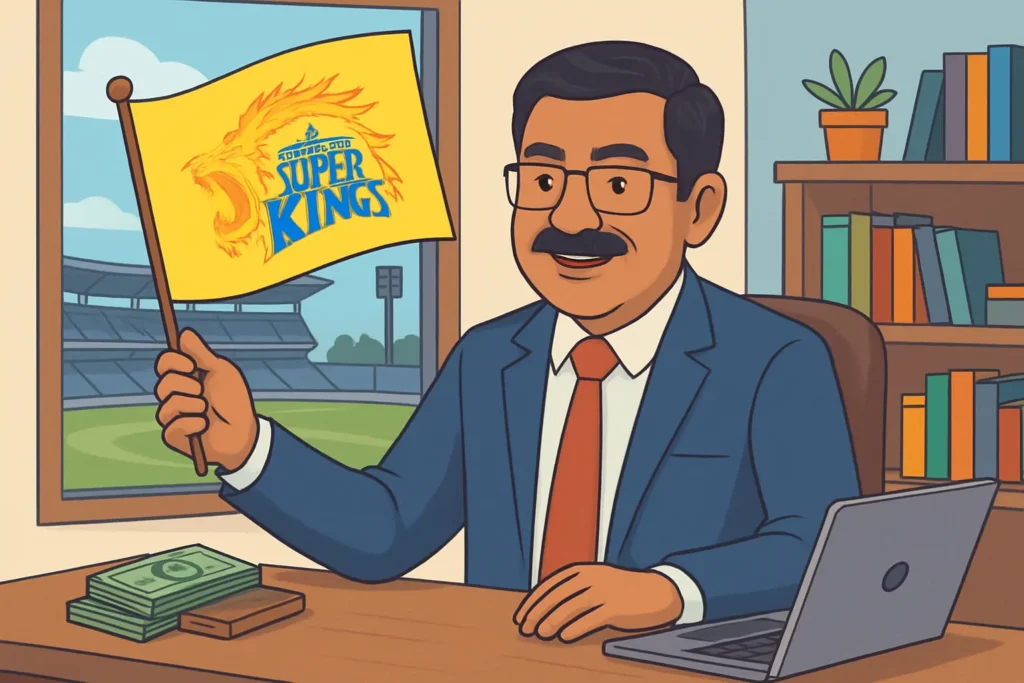
Chennai Super Kings is owned and operated by Chennai Super Kings Cricket Limited (CSKCL), an unlisted public company based in Chennai. The company emerged from India Cements’ franchise business and remains closely associated with the India Cements promoter group, with N. Srinivasan widely recognized as the key figure behind CSK. The day-to-day cricket operations are led by CEO Kasi Viswanathan, with MS Dhoni defining the team’s on-field identity.
CSK owner at a glance
- Franchise: Chennai Super Kings (CSK), Indian Premier League
- Legal owner: Chennai Super Kings Cricket Limited (CSKCL)
- Type: Unlisted public company
- Key associated figure: N. Srinivasan (promoter group)
- CEO: Kasi Viswanathan
- Head coach: Stephen Fleming
- Relationship to India Cements: CSK originated within India Cements; the franchise business was later moved into CSKCL, a separate company. Promoter interests overlap.
- Listing status: Not listed on stock exchanges
- Headquarters: Chennai
Why this matters
Ownership is not just a legal footnote with CSK; it’s a living story of continuity. A corporate spine backed by India Cements’ promoter group, an unflappable CEO who runs the back room like a metronome, and a cricket culture built by Dhoni and Fleming. Stability at the top has bred stability in selection, scouting, and retention. The yellow jersey was stitched with quiet governance.
How CSK ownership actually works
Forget the jargon and filings for a moment. Think of the IPL as a league run by the BCCI. Each team is a franchise that holds a right-to-participate under a long-term agreement. For CSK, those rights sit inside a company called Chennai Super Kings Cricket Limited. That company employs the people, signs sponsorships, books the hotels, manages the brand, and—critically—executes the franchise agreement with the BCCI.
The CSK story began with India Cements. The cement giant won the franchise rights at the IPL’s formation and subsequently shifted the team into a dedicated vehicle, CSKCL. That shift did two things: it ring-fenced the cricket business into its own company, and it gave investors and stakeholders a cleaner view of what CSK was worth on its own. The promoter lineage stayed consistent—N. Srinivasan and the India Cements family remained the human constants—even as the corporate wrapper evolved.
Today, CSKCL is the entity you’ll see on contracts and in sponsor backdrops. It’s unlisted, which means there’s no daily share ticker. But it’s not a closed book either. Shares circulate in the unlisted market, and investor interest balloons every pre-season. Equally important, the organization maintains a management style indistinguishable from its early days: lean, low-drama, with operational control entrusted to true cricket people.
A timeline of key ownership milestones
The winning bid at the inaugural IPL rights auction
A corporate heavyweight, India Cements, secured the Chennai franchise rights. The logic was sound: a South Indian industrial brand with deep regional roots, strong sports patronage, and long experience in cricket administration stepping into a commercial cricket venture built for television, ticketing, and sponsors.
Transfer to a dedicated company
As the IPL grew, India Cements moved the franchise business into a separate company—Chennai Super Kings Cricket Limited. This wasn’t just shuffling paper. It allowed the cricket business to live under its own governance framework. It also made it clearer to stakeholders how the franchise was performing independently of the cement business.
Suspension and the return
CSK navigated a high-profile off-field storm that led to a two-season suspension. That period could have broken the brand. Instead, the ownership and management responded in the way CSK tends to do most things: quietly. Core personnel were retained or courted, a pipeline was patiently rebuilt, and when the team returned, it did so with the same mission statement that powered its early dominance—clarity in roles and unwavering trust in experience.
Expansion into global T20
CSKCL and its closely allied entities extended the brand into other leagues. The Joburg Super Kings in South Africa and Texas Super Kings in the United States carry Chennai DNA—yellow kits, familiar faces, and the same understated management approach. For fans, it’s more than merchandising; it’s a network, a way to see the CSK philosophy stress-tested in different conditions.
Consolidation and modernization
As revenues scaled league-wide, CSK’s owners focused on refinement: improving fan experience at the Chepauk, deepening digital content, formalizing talent pathways through local tournaments, and strengthening long-horizon sponsorships. If you’ve noticed the brand is more global, that’s by design. If you’ve noticed the cricket stays stubbornly local, that’s by design too.
The India Cements connection, explained
To the uninitiated, the CSK–India Cements relationship looks like a riddle. Here’s the clean version.
The origin point
India Cements acquired the franchise rights for the Chennai IPL team. The company has decades of engagement with cricket—sponsoring tournaments, supporting associations, and employing administrators who understand the sport’s politics and economics.
The corporate shift
India Cements moved the franchise into a separate company, CSKCL. This gave CSK its own balance sheet and governance while keeping promoter influence intact. Such ring-fencing is common in sports businesses worldwide; it simplifies everything from sponsor negotiations to banking relationships.
Who runs what today
CSKCL runs the team. India Cements is a separate listed company. Key individuals overlap: N. Srinivasan, the long-time face of India Cements and a major figure in Indian cricket administration, remains the most recognized name associated with CSK’s ownership. Rupa Gurunath—his daughter—has been a prominent business figure in the broader ecosystem. For the average fan: yes, the India Cements promoter family is the CSK power center, but the team sits inside its own company.
Is India Cements the owner of CSK?
The short, precise answer: the owner is Chennai Super Kings Cricket Limited. The India Cements connection is historical and promoter-led, not a simplistic parent-subsidiary label that tells the full story today.
The people behind CSK’s ownership and day-to-day control
N. Srinivasan and CSK
Few names in Indian cricket administration carry as much weight. Srinivasan is the promoter face behind CSK’s ownership arc. He understood early that the IPL was not just a tournament but a franchise ecosystem where patient capital, astute management, and steady dressing-room culture would beat hot money and impulsive decision-making. Ask around Chepauk and you’ll hear the same refrain: “Clarity from the top has been the constant.”
Rupa Gurunath
From the business side of the India Cements world, Rupa brought an executive’s eye to cricket. She has held leadership roles in the broader cricket and business ecosystem and has been part of the promoter group’s continuity. Her name appears anytime people map the India Cements–CSK lineage, and rightly so; the family remains central to the franchise’s identity.
Kasi Viswanathan, CEO
If CSK had a heartbeat inside a boardroom, this would be it. The CEO is the conduit between ownership and cricket. Talk to players or staff who’ve passed through the CSK setup, and you’ll hear about calm phone calls late at night, a methodical approach to contracts, and an invariable “We’ll take a call after speaking to the captain and coach.” Viswanathan’s management style is low-profile and remarkably consistent—exactly the kind of temperament a franchise needs to survive heat spells on and off the field.
Stephen Fleming, head coach
Fleming is not “ownership,” but his influence is baked into the organizational DNA. Owners who genuinely empower cricket brains create durable teams. CSK’s board has repeatedly shown trust in Fleming’s softly-spoken authority: cleaner roles, fewer experiments for the sake of it, and respect for experience when battle temperatures rise.
MS Dhoni, the myth and the truth
Dhoni is not the owner of CSK. He is, however, the cultural architect. Ownership set the tone for stability; Dhoni built the blueprint for how that stability translates into on-field decisions. A typical CSK meeting under Dhoni is brisk: assess conditions, speak briefly, align on roles, get out of the room. He has been involved in retention calls and auction strategy, but not from a chair at the table labeled “owner.” The clarity helps everyone.
How the CSK business makes money
If you’re trying to understand the CSK owner story from a finance angle, follow the money rather than the myth. The franchise monetizes through:
- Central pool distribution: The IPL’s broadcasting and digital rights feed a central pot managed by the league. Franchises receive a share, forming the dependable spine of CSK’s revenue.
- Team sponsorships: The front-of-shirt sponsor, sleeve partners, upper chest logos, back-of-shirt, and training kit partners—each of these slots is negotiated by CSKCL. Long-term partners stick around precisely because the ownership does not yank the wheel with every breeze.
- Ticketing and match-day: Chepauk on a humid evening, decibels raking the sky, and a full house of yellow. Gate receipts matter, especially with consistent knockout qualifications, which push more home dates into the calendar.
- Licensing and merchandise: From classic yellow jerseys to lifestyle apparel and kids’ lines, CSK’s brand presence travels beyond match day. The expansion into overseas sister teams has helped keep the brand in circulation through the year.
- Prize money and performance-linked revenues: Success compounds brand value, and in CSK’s case, finishing deep into tournaments is a pattern, not an accident. That shows up in prize money, partner bonuses, and organic fan growth.
- Digital and content: Match clips, behind-the-scenes diaries, documentary features, and fan engagement campaigns build retention. Ownership invested early in savvy content teams, allowing CSK to own its narrative.
Brand value, valuation, and what those numbers really mean
Pick any serious brand valuation study and CSK sits near the top of the list, often sparring with Mumbai for first place. Brand value is not equity value—it’s a measure of the franchise’s intangible market power. The equity value (what the company could be worth in a transaction) is driven by cash flows, league growth, and scarcity; there are only so many IPL teams, and demand runs ahead of supply.
A word on “CSK owner net worth” searches: fans often conflate a promoter’s personal wealth with a club’s valuation. They are different measurements. What matters for sustainability is not any one person’s bank balance but the predictability of cash flows, the durability of the brand, and the quality of governance. CSK scores well on those metrics.
Is CSK listed? What about a CSK IPO?
- Listing status: Chennai Super Kings Cricket Limited is not listed on stock exchanges.
- Unlisted shares: CSKCL shares trade in the unlisted market via intermediaries that facilitate off-market transfers. Prices move with news cycles, team performance, and general IPL sentiment. These trades are not exchange-settled and carry liquidity and counterparty risks.
- IPO chatter: A public offer has been a recurring topic among fans and unlisted investors. Unless the company files and announces formally, it remains chatter. Ownership’s approach to date has been conservative and timing-driven—patient capital prefers clean windows to list. If they believe a listing enhances long-term governance and access to capital without diluting control in unhelpful ways, they will act. Until then, it’s business as usual: build the brand, compete for titles, keep the balance sheet tidy.
CSK ownership structure, in plain English
- The franchise is owned by Chennai Super Kings Cricket Limited (CSKCL).
- CSKCL was created to house the IPL team as a discrete business, moved out from within India Cements’ direct books.
- The company is unlisted and has a shareholding that reflects the demerger’s outcome and subsequent placements, with the promoter group retaining significant influence.
- Operational governance separates board-level oversight from cricket decisions. The CEO bridges the two worlds, enabling the on-field team to function with autonomy.
Why the CSK model works
Because governance mirrors tactics. That’s the secret. On the field, CSK invests in clarity: roles defined, panic minimized, selections explained. Off the field, ownership invests in structure: a dedicated company, low executive churn, sponsorship relationships that don’t get reset every cycle, and a CEO who distrusts drama. This symmetry turns out to be a profound competitive advantage. When a big auction throws the room into chaos, CSK behaves like a value investor: identify who fits the system, pay fairly, leave the ego at the door.
Real-world examples from inside the yellow machine
Chepauk selection meetings
On humid evenings, with dew a real variable, you’ll see CSK split discussions three ways: Dhoni on match-ups and over-by-over stress points, Fleming on player roles over a tournament arc, and Viswanathan on cap and contract implications. Ownership’s presence is invisible but felt—the process, not the person, does the heavy lifting.
Veteran trust and the “last-over calm”
CSK has a pattern of backing seasoned pros for defined roles. That’s not sentiment; it’s an ownership-choice to resist social media noise. The logic is hard to miss: in chaos overs, nerves cost more than raw pace. That kind of thinking survives only if the board is aligned with the dressing room.
Talent pathways from local cricket
CSK scouts quietly in Tamil Nadu’s circuits, TNPL, and select age-group competitions. The owners’ Chennai roots make this pipeline natural. Discoveries often arrive without fanfare: a domestic all-rounder used as a floater, a seamer with a heavy ball, a leggie who bowls stump to stump under pressure. Less glitz, more fit.
Comparison: IPL team owners list
The IPL ecosystem makes sense when you view CSK alongside its peers. Here’s a concise team-wise snapshot of ownership entities and the faces most fans recognize.
Team-wise owners (concise overview)
- Chennai Super Kings (CSK): Chennai Super Kings Cricket Limited; key figure N. Srinivasan; CEO Kasi Viswanathan.
- Mumbai Indians (MI): Indiawin Sports Private Limited (Reliance Industries group); key figure Nita M. Ambani; Akash Ambani involved in team operations.
- Kolkata Knight Riders (KKR): Knight Riders Sports Private Limited; key figures Shah Rukh Khan (Red Chillies Entertainment), Juhi Chawla & Jay Mehta (Mehta Group).
- Royal Challengers Bangalore (RCB): Royal Challengers Sports Private Limited (United Spirits, part of Diageo); key figure Prathmesh Mishra in leadership roles.
- Sunrisers Hyderabad (SRH): Sun TV Network; key figure K. Shanmugam in top management, Kalanithi Maran as promoter.
- Rajasthan Royals (RR): Emerging Media IPL Ltd led by Manoj Badale with investor partners; ownership is a consortium structure.
- Delhi Capitals (DC): JSW GMR Cricket Private Limited (joint venture of JSW Group and GMR Group); key figures Parth Jindal and Kiran Kumar Grandhi.
- Punjab Kings (PBKS): KPH Dream Cricket Private Limited; promoters include Mohit Burman, Ness Wadia, Preity Zinta, and partners.
- Gujarat Titans (GT): CVC Capital Partners affiliate; leadership team manages cricket operations under franchise entity.
- Lucknow Super Giants (LSG): RPSG Group (Sanjiv Goenka); operations run through RPSG’s sports arm.
Note: Ownership structures can evolve through internal restructurings or new investments. The broad picture above reflects prevailing, widely acknowledged control.
Does Dhoni own CSK? And other myth busters
- Dhoni is the face, not the owner: He has never been the owner of Chennai Super Kings. He is the leadership engine on the field and a consultative voice in retention and auction planning.
- India Cements and CSK: one and the same? No. The team is owned by CSKCL, a separate company. The India Cements promoter group is deeply connected and historically central, but these are distinct entities.
- CSK’s two-season absence meant an ownership change? No. The franchise returned under the same ownership umbrella. The management and culture were reassembled almost piece by piece.
- Is CSK for sale? There is no credible indication of a sale. Unlisted shares changing hands in private markets do not mean a change in control.
- Is CSK a listed stock? No. Any “CSK share price” you hear about relates to the unlisted market, not exchange-traded equity.
CSK ownership and the cricket room: how control translates to consistency
The best owners in sport make themselves redundant in the dressing room. CSK’s model is textbook.
- Contract strategy: CSK rarely chases the loudest trend. They invest in all-rounders who free up the XI, value left-right batting combinations, and avoid bloated benches. That conservatism comes from boardroom patience.
- Injury cover and calm pivots: When a key player goes down, the temptation is to replace role with star power. CSK tends to replace role with role. It’s a philosophy only possible if the owners aren’t waving hands for headlines.
- Auction tactics: Look for the moments when the room gets excited about a breakout star. CSK often sits out early bidding wars, returning later for players who fit a known template—power at the death, smart spin under pressure, a utility domestic pacer whose economy is built on clever angles. Ownership’s mandate to the auction table is simple: don’t win the room, win the tournament.
CSK management team: names that matter
- Chairman/Promoter face: N. Srinivasan (widely associated with CSK ownership and stewardship)
- CEO: Kasi Viswanathan
- Head Coach: Stephen Fleming
- Team Management Support: A small, trusted operations crew that handles logistics, contracts, and compliance
- Captain: MS Dhoni (club legend; leadership influence even when not wearing the armband)
Who owns Chennai Super Kings? The definitive answer, with context
The owner of CSK is Chennai Super Kings Cricket Limited, an unlisted public company headquartered in Chennai. The company originated from a demerger of India Cements’ franchise business, and the India Cements promoter family—most publicly, N. Srinivasan—remains the key influence. That’s the legal and practical truth. Around that truth sits a well-oiled management machine and a cricket leadership group that have kept the team consistently competitive.
CSK shareholding pattern and investor interest
Because the company is unlisted, the exact shareholding split isn’t broadcast daily. What is known:
- Promoter influence is strong, consistent with the company’s origin and governance.
- Shares exist in many hands, including investors who received allocations through the demerger process and later transfers.
- Private-market interest in CSKCL stock tends to spike around auction windows and playoff runs.
- Without exchange disclosures, fans should be wary of anyone presenting precise, current percentages as gospel without documentation.
Revenue cycles and spending control
CSKCL operates within the IPL’s financial framework. The league’s central revenue distribution provides a stable base, allowing clubs to plan multi-season retainers and support staff development. CSK’s spending philosophy is disciplined: commit to core player groups, maintain headroom for targeted buys, and prioritize cricket infrastructure that yields outsized returns—analysis, scouting, and continuity.
If you’ve ever wondered why CSK rarely looks frantic, this is why. Ownership designed a system where the financial calendar and the cricket calendar align, limiting surprises and smoothing out volatility.
The cultural dividend of steady ownership
- Retention beats reinvention: Teams that rip up their blueprint every cycle burn cash and points. CSK’s owners bet on memory and chemistry, preserving combinations that thrive in Chennai’s specific conditions—stubborn surfaces, tactical dew, and a crowd that knows when to turn the volume up.
- Leadership trust: The ownership-to-CEO-to-coach-to-captain chain moves information quickly and cleanly. When decisions are made, they stick. That consistency helps young players understand where they stand and what they need to work on.
- Sponsor alignment: Brands appreciate quiet. CSK’s deck is rarely swamped with last-minute changes, and that builds sponsorship longevity. Long relationships turn into joint campaigns, not mere logo placements.
CSK vs other IPL owners: what’s different?
- Origin story: A listed industrial group bought into sport, then carved out the team into a separate company. That origin gave CSK big-company controls without smothering the cricket room.
- Chennai roots: Deep ties to Tamil Nadu’s cricket ecosystem make CSK a blend of global business and local heritage. Fans are not “customers” here; they’re stakeholders in a public ritual.
- Global branch lines: The Joburg and Texas extensions give CSK a laboratory to refine talent and staff. That multi-team view, still early in its evolution, will matter more as player workloads and availability become puzzle pieces across leagues.
- The Dhoni effect: Few franchises in sport have a leader whose presence changes the team’s pulse so completely. CSK’s owners didn’t just get lucky with Dhoni; they built a setup where his strengths would stick to the walls—method, poise, trust.
Regional-language quick answers
Hindi
- CSK ka malik kaun hai? Chennai Super Kings ka malik Chennai Super Kings Cricket Limited hai. N. Srinivasan aur India Cements promoter group isse juda hua hai. Cricket operations ka zimma CEO Kasi Viswanathan sambhalte hain.
- CSK ke owner kaun hai? Company ka naam Chennai Super Kings Cricket Limited hai; key figure N. Srinivasan se jodi hui ownership lineage hai. Dhoni owner nahi hai; woh team ke leader aur culture ke architect hain.
Tamil
- CSK oda owner yaru? CSK oda owner Chennai Super Kings Cricket Limited. India Cements promoter group-oda sambandham irukku; N. Srinivasan perumaiya pathi pesuvanga. Day-to-day work ah CEO Kasi Viswanathan nadathararu.
- CSK owner in Tamil: CSK-ai Chennai Super Kings Cricket Limited own panrathu. Dhoni owner illa; avar team leader.
Frequently asked questions about the CSK owner
Who owns Chennai Super Kings?
Chennai Super Kings is owned by Chennai Super Kings Cricket Limited, an unlisted public company formed to operate the IPL franchise. The India Cements promoter family, most notably N. Srinivasan, remains the key influence behind the franchise.
Does MS Dhoni own CSK?
No. Dhoni is the most influential on-field leader in CSK history, and he is involved in cricket matters such as retention strategy. Ownership rests with Chennai Super Kings Cricket Limited.
Is CSK owned by India Cements?
CSK was born within India Cements’ franchise portfolio and later moved into a separate company, CSKCL. The promoter lineage connects the two, but they are different entities.
Is CSK a listed company?
No. CSKCL is unlisted. Any references to a “CSK share price” typically relate to unlisted market quotes, not a stock exchange listing.
Who runs CSK on a day-to-day basis?
CEO Kasi Viswanathan runs operations, coordinating with the coach and captain. Board-level oversight and promoter guidance set the direction without daily micromanagement.
What is the CSK owner net worth?
That question mixes personal wealth with a corporate asset. CSK’s strength lies in its cash flows, brand value, and governance—metrics that sustain teams regardless of any one individual’s personal balance sheet.
How does CSK compare with MI, RCB, KKR owners?
Each franchise has a different corporate parent and personality. Reliance underpins MI with scale, JSW-GMR runs DC as a joint venture, Sun TV backs SRH, RPSG anchors LSG, and CVC-backed structures hold GT. CSK’s identity is distinct: a franchise carved from a listed industrial group into a standalone company with deep promoter continuity and a famously hands-off approach to cricket tactics.
Ownership, controversies, and the long game
CSK’s ownership story has lived through scrutiny. Off-field controversies tested the franchise’s resilience and the promoter group’s ability to handle crisis. The club’s response became a case study in sports governance: accept penalties, maintain core people, keep communication sparse and credible, and rebuild in the open. The owners’ decision to trust experienced leaders in the cricket room paid off. The brand didn’t just survive; it grew.
That is the quiet truth about ownership: you learn more about it when things go wrong. CSK’s owners absorbed a reputational blow, navigated formal sanctions, and emerged with the franchise’s competitive edge intact. That doesn’t happen accidentally. It happens when power is distributed with intent and the board respects the sanctity of the dressing room.
Why the ownership of CSK still fascinates fans
- A team that feels like a city: Chennai doesn’t cheer as an audience; it cheers like a council. Ownership’s long-term approach allowed bonds to form—with players who became family names, with a stadium that breathes in a certain rhythm, and with a captain whose silences are as communicative as most press conferences.
- Business clarity: Fans who love numbers gravitate to CSK because the lines are clean. A separate company, a stable promoter face, a CEO who speaks when it matters, and a coach-captain axis that rarely contradicts itself in public.
- Stability amidst churn: Leagues change. Rules shift. Auctions reset squads. Amid that churn, CSK’s ownership has engineered a shelter for cricket sense. A veteran can fail without losing his career in a day. A youngster can breathe into a role. That’s not luck. That’s architecture.
CSK’s soft-power advantage: the owner’s imprint on strategy
- Chennai conditions as strategy: Ownership backed a philosophy built on home conditions. Squad construction leans into slow-surface smarts: finger spin that can bowl to fields, seamers who hit into the pitch, and batters who value angles over brute force. You don’t commit to that kind of plan for years unless the owners are comfortable with identity over fashion.
- Calm captains, calm contracts: Contract cycles are where owners can spook players. CSK tends to do the opposite: fewer shock releases, clear calls communicated early, and honest feedback loops. Agents talk; CSK has a reputation for not over-promising and not under-delivering.
- Stars sharing space with role players: Some of CSK’s most valuable contributors have been specialists: a powerplay bowler who swings the new ball, a middle-over accumulator who turns strike sublimely, a late-overs hitter who doesn’t need rhythm to find the boundary. That blend comes from a franchise that understands winning is an orchestra, not a guitar solo.
A crisp owners’ comparison list (team-wise)
- CSK: Chennai Super Kings Cricket Limited; N. Srinivasan as key promoter figure; CEO Kasi Viswanathan.
- MI: Indiawin Sports (Reliance); Nita M. Ambani and Akash Ambani front team stewardship.
- RCB: Royal Challengers Sports (United Spirits/Diageo); corporate leadership coordinates cricket ops.
- KKR: Knight Riders Sports; Shah Rukh Khan, Juhi Chawla, Jay Mehta public faces.
- SRH: Sun TV Network; Kalanithi Maran’s group.
- RR: Emerging Media; Manoj Badale-led consortium with partners.
- DC: JSW-GMR joint venture; Parth Jindal and Kiran Kumar Grandhi.
- PBKS: KPH Dream Cricket; Mohit Burman, Ness Wadia, Preity Zinta among promoters.
- GT: CVC Capital affiliate.
- LSG: RPSG Group; Sanjiv Goenka.
Inside the boardroom: how decisions flow
- Budget framing: Before auctions, the board outlines budget envelopes and priority roles. There’s little appetite for splurges that hamper flexibility.
- Cricket committee sync: Coach and captain present role maps—who fits where, how combinations change across venues, what contingencies exist. The CEO aligns this with contracts and cap math.
- Ownership oversight: Promoter-level oversight ensures the franchise stays aligned with its long-term identity and brand commitments. It’s not about who bats at three; it’s about the long arc of how CSK plays and wins.
- Review cadence: The franchise favors quiet, internal debriefs over public posturing. After a season, there are no theatrics. There is a ledger of decisions, what worked, what didn’t, and where the team needs fresh legs or fresh ideas.
For fans tracking “CSK share price unlisted”
- Unlisted shares are bought and sold off-exchange through intermediaries.
- Price discovery is informal; quotes can vary across brokers.
- Liquidity is inconsistent; settlement depends on counterparties.
- Events that can nudge prices: major sponsorships, knockout runs, marquee player moves, and any concrete listing news.
- Always treat unlisted investments with caution; absence of daily disclosures means you carry information risk.
What to expect next from CSK’s owners
- More method, less noise: The core ownership philosophy is unlikely to change. Expect continuity in leadership roles, with succession planned rather than improvised.
- Global T20 footprint: The Joburg and Texas footprints should mature, creating talent and staff pipelines that flow both ways. If scheduling allows, shared analytics and sports science frameworks will deepen.
- Fan experience upgrades: Chepauk’s matchday experience will continue to improve: better ingress, improved merchandise access, and smarter digital engagement for ticketing and membership programs.
- Brand partnerships with depth: Rather than a carousel of sponsors, expect multi-year partnerships that activate at grassroots, digital, and international levels. CSK’s owners have long preferred fewer, deeper relationships to a crowded, shallow roster.
Key takeaways
- The owner of CSK is Chennai Super Kings Cricket Limited, an unlisted public company formed from India Cements’ franchise business.
- N. Srinivasan and the India Cements promoter family are the central figures behind CSK’s ownership narrative.
- CEO Kasi Viswanathan anchors the day-to-day, with Stephen Fleming and MS Dhoni shaping the cricket blueprint.
- CSK’s success is governance-led: a steady board, a clear franchise identity, and trust in specialists.
- The company is not listed; unlisted shares trade privately and carry typical off-market risks.
- CSK’s brand value sits at the top of the league, reflecting stable ownership, consistent performance, and deep fan connection.
Closing thoughts: why this ownership story endures
Chennai Super Kings stands as a case study in how to build a sports franchise in India: start with strong promoters who understand both business and cricket; create a separate company that gives the team its own life; hire a CEO who treats logistics and contracts as high craft; hand the dressing room to people whose calm is contagious; and never, ever trade identity for trend.
The easy part in modern sport is throwing money at a problem. The hard part is staying yourself. CSK’s owners made a bet long ago that cricket decisions thrive in low-noise environments, that loyalty has a return on investment, and that a city’s love is earned by respecting its rhythms. The bet worked. It still works. And as long as CSKCL keeps that pact—with the city, with the players, and with the process—Chennai will keep pouring into Chepauk, voices up, flags high, believing that the next ball bowled is part of a plan that started long before any of us noticed.