
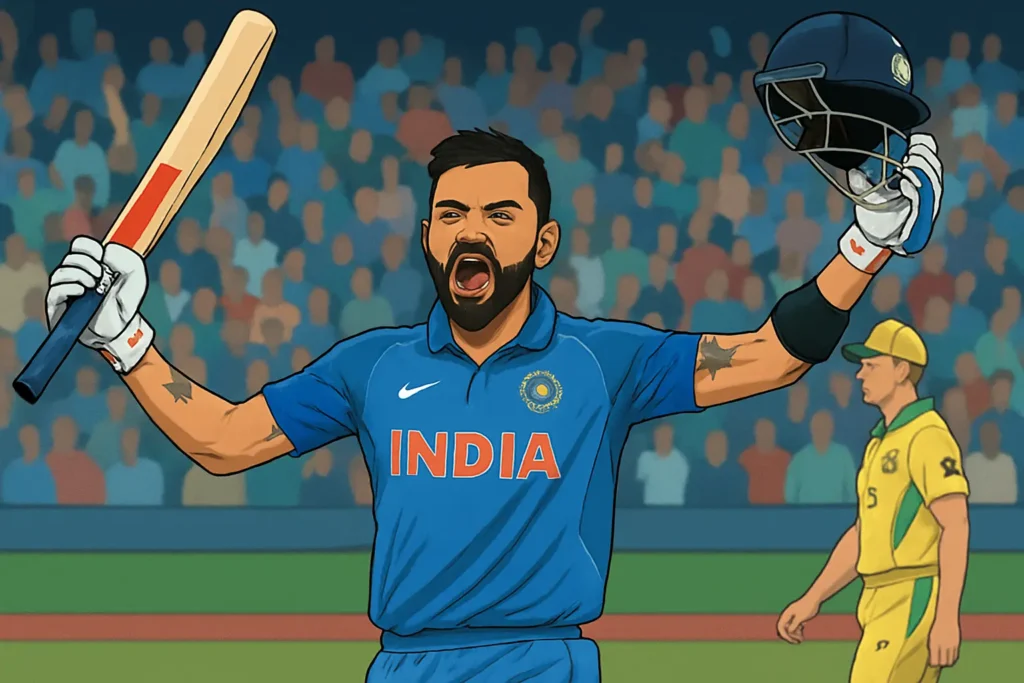
Virat Kohli’s hundreds against Australia sit at the crossroads of craft and combat. The settings tell their own story: Adelaide skies turning amber as he leans into the cover drive; the MCG’s cathedral hush just before the ball meets the middle; a choked chase in Canberra; a bruising epic in Ahmedabad; a Jaipur night when tempos changed in an instant. These tons aren’t just marks on a ledger. They carry the heat of the rivalry that has shaped Indian batting’s modern ethos: discipline early, domination late; respect for the game’s hardest questions and the confidence to answer them on his own terms.
This is the definitive, evergreen hub for Virat Kohli centuries against Australia — every hundred listed cleanly by format and venue, verified totals, and the editorial context that statistics alone can’t convey. It’s also built for users who want more than a list: the chases, the fastest, the highest, the venues he owns, and the tactical patterns that repeat across formats. Updated through the most recent India–Australia meetings.
Virat Kohli centuries against Australia: snapshot and key totals
- Total hundreds vs Australia (all formats): 15
- Test centuries vs Australia: 8
- ODI centuries vs Australia: 7
- T20I centuries vs Australia: 0
- Highest score vs Australia: 186 (Test, Ahmedabad)
- Highest ODI score vs Australia: 123 (Ranchi)
- Fastest century vs Australia: 100* off 52 balls (ODI, Jaipur)
- Most centuries at a single venue vs Australia: Adelaide Oval (3 in Tests + 1 in ODIs)
- In Australia: 6 Test hundreds, 3 ODI hundreds
- In India: 2 Test hundreds, 4 ODI hundreds
- In successful ODI chases vs Australia: 4 hundreds (Visakhapatnam, Jaipur, Nagpur, Adelaide)
- Last Test hundred vs Australia: 186 in Ahmedabad
- Last ODI hundred vs Australia: 123 in Ranchi
Why Australia brings out a particular Kohli
Australia’s bowlers probe the same zones that tempt stroke-players to self-destruct: the fourth-stump channel across formats, the hard length that climbs quicker than expected, the constant bait of the fuller line when a batter is set. Kohli’s method meets that challenge in ways both technical and psychological. He rides the new ball with restraint — head still, hands under the ball, front shoulder committed — and turns tempo once the ball softens or fields fracture. Against Starc and Hazlewood he’s ruthless to anything overpitched; against Pat Cummins he shrinks scoring areas, trusting singles until a faulty length appears; against Nathan Lyon he uses forward press and soft hands to turn off-stump threats into run milkers; against Adam Zampa he drags length with decisive feet, conditioned by a rock-solid off-stump game.
The upshot: when the game requires a chess player, he plays chess; when it calls for a street fighter, he swings with guile. That duality defines his tons vs Australia, especially the cold-blooded ODI chases and the Adelaide dramatics.
Virat Kohli Test centuries vs Australia: full list and context
Kohli’s Test hundreds against Australia track a line from early survival to full bloom, from lone-hand resistances to match-shaping statements. He has Test tons across India’s major venues and Australia’s most storied grounds, with a pronounced love affair at Adelaide Oval and a landmark comeback epic in Ahmedabad.
Test hundreds vs Australia — the list at a glance
- Chennai (Chepauk) — 107 — India win — Dhoni’s double-ton game; Kohli’s controlled seam play laid the platform for an innings victory push.
- Adelaide Oval — 116 — India loss — first Test hundred in Australia; back-foot mastery and a combative hundred in a heavy defeat.
- Adelaide Oval — 115 — India loss — first innings of a dramatic Test; compact drives, pristine judgment outside off.
- Adelaide Oval — 141 — India loss — fourth-innings masterpiece in a tight chase; aesthetics and intent in equal measure.
- Melbourne (MCG) — 169 — Draw — a long, regal innings; grand stand with Ajinkya Rahane broke an Australian rhythm that had felt suffocating.
- Sydney (SCG) — 147 — Draw — late-series affirmation; handled reverse swing and the Lyon maze with stride and soft hands.
- Perth — 123 — India loss — bounce, glare, and character; a counter-punching beauty with iron control on the short ball.
- Ahmedabad — 186 — Draw — a marathon; tempo patience, late acceleration, and a tactical masterclass on a slow burner of a pitch.
Test centuries vs Australia — editorial notes
- Adelaide’s hold: Three Test tons at the Oval, including those famous twin hundreds as captain on debut in the role. Each carried the same outlines — a lawful leave, the cover-drive as punctuation, and a relentless hunger deep into the second session.
- Perth 123: The truest test for his defensive technique and pull-shot courage on a sporty deck. It was old-school survival fused with modern scoring windows, earned with hard hands turning soft at the last millisecond.
- Melbourne 169: The partnership with Rahane doubled as a manifesto: India’s top order would not be dictated to. Anything full was a boundary if it strayed; anything short was carved square. The message echoed beyond the game.
- Ahmedabad 186: A re-centering epic. He batted like a conductor — tempo low, tension minimal, release points chosen carefully. Patience was the strategy; exhaustion the weapon. Australia’s lines blurred as he collected runs in calm sweeps.
Virat Kohli ODI centuries vs Australia: full list and context
In ODIs, Kohli against Australia is often the most complete version of the modern chaser: gate closed on risk in the first twenty balls, engine engaged by the thirtieth, ruthless by the fortieth. There are pace-on assaults and spin-control clinics, but always the same values: batting in layers, trusting the next boundary to arrive, turning big games into solvable equations.
ODI hundreds vs Australia — the list at a glance
- Visakhapatnam — 118 — Chasing — India win — an early signature; clean strokes through cover and midwicket in a stiff pursuit.
- Jaipur — 100* (off 52 balls) — Chasing — India win — lightning; the fastest ODI hundred of his career, revolutionizing a tall chase alongside Rohit Sharma.
- Nagpur — 115* — Chasing — India win — flawless pacing; the chase looked monumental until he made it look routine with strip-mining singles and sudden sixes.
- Melbourne (MCG) — 117 — Batting first — India loss — a classy statement that couldn’t prevent a relentless Australian reply.
- Canberra — 106 — Chasing — India loss — innings control for three-quarters of a game; a collapse later stole the narrative.
- Adelaide Oval — 104 — Chasing — India win — poised in the middle overs, imperious at the death; classic finishing partnership with MS Dhoni.
- Ranchi — 123 — Chasing — India loss — a fighting hundred in a defeated cause; Australian seamers held their nerve late.
ODI centuries vs Australia — editorial notes
- The Jaipur hundred: A release of all the pent-up ODI thinking about chases. No slogging, just precision at absurd speed. Fifty became a hundred within the blink of an eye; Australia didn’t have time to adjust fields, let alone plans.
- The Adelaide finish: The craft of chases distilled — low-risk gaps, a disdain for panic, and the knowledge that a single over can flip a match. Dhoni’s presence amplified the aura; Kohli’s certainty set the tone.
- Visakhapatnam’s breakthrough: In heavy dew and hard white-ball conditions, he placed his cover drive like a compass needle. It established a template he would later perfect — win the chase on length control, not just with hitting.
- The heartbreaks: Canberra and Ranchi testify that even a Kohli hundred doesn’t guarantee a win. Australia play the endgame well; his hundreds in those losses highlight how thin the margins can get.
Virat Kohli hundreds vs Australia: home vs away split
- Tests: 2 at home (Chennai, Ahmedabad); 6 in Australia (Adelaide thrice, Melbourne, Sydney, Perth)
- ODIs: 4 at home (Visakhapatnam, Jaipur, Nagpur, Ranchi); 3 in Australia (Melbourne, Canberra, Adelaide)
That split tells you two truths. First, his most romantic innings unfold under Australian skies; he relishes the bounce and the wide fields where gaps become runways. Second, he has converted India’s pressure-cooker chases into workshops of control, often partnering with Rohit Sharma, Shikhar Dhawan, or MS Dhoni to squeeze the life out of a target.
Venue-wise breakdown: where the tons came and why they matter
Adelaide Oval
- Test hundreds: Three. A living museum of his technique: leaves that demoralize, drives that slice the outfield. The twin tons in a gripping Test showed willpower under a cloud of tension. The earlier hundred announced his arrival as a big-stage Test batter in Australia.
- ODI hundred: One. The perfect chase pitch; he waited for the seamers to err fuller and then unfurled the whip through midwicket and the drill through extra-cover.
Melbourne Cricket Ground (MCG)
- Test hundred: One (169). He and Rahane owned the day; the outfield’s fast, the boundary dimensions vast, and he found both angles and patience.
- ODI hundred: One (117). Australia’s reply overpowered India, but the hundred had poise and perfectly weighted drives.
Sydney Cricket Ground (SCG)
- Test hundred: One (147). Against reverse and Lyon’s long spells, he kept batting shapes simple and wrists pliable. The innings lingers for its calm rather than its fireworks.
Perth
- Test hundred: One (123). The bounce tempted horizontal-bat shots; he accepted the invitation but never gambled, rolling wrists late and wearing Australia’s pace like armor rather than a wound.
Indian venues
- Visakhapatnam (ODI): 118 in a chase — an early masterclass in target control.
- Jaipur (ODI): 100* off 52 — sheer speed, no slog; the statement that changed chase talk for a generation.
- Nagpur (ODI): 115* chipping away at a mountain with strokes along the carpet.
- Ranchi (ODI): 123 in a losing chase — valiant and stylish, but a case study in how well Australia defend totals at the death.
- Chennai (Test): 107 — part of an innings that broke Australia’s early optimism.
- Ahmedabad (Test): 186 — a long meditation in whites, built brick by brick.
Records and angles: highest, fastest, chases, series nuggets
- Highest score vs Australia: 186 in a Test at Ahmedabad.
- Highest ODI score vs Australia: 123 at Ranchi.
- Fastest century vs Australia: 100* off 52 balls, Jaipur ODI; this is also his fastest ODI hundred overall.
- Centuries in successful ODI chases vs Australia: Visakhapatnam 118, Jaipur 100*, Nagpur 115*, Adelaide 104.
- Most centuries vs Australia at a venue: Adelaide Oval (four centuries, across formats).
- Border-Gavaskar context: Eight Test tons against Australia, spread across India and Australia, including a run of sustained excellence across Adelaide, Melbourne, and Sydney, then later a patience epic in Ahmedabad.
Average and strike-rate profile (updated through the latest meetings)
- Test average vs Australia: right around the fifty mark, reflecting both the volume of runs and a habit of going big when set.
- ODI average vs Australia: in the mid-fifties, a product of high conversion in chases and consistency across conditions.
- ODI strike rate vs Australia: mid- to high-nineties, with spikes during chase accelerations and Powerplay 2 exploitation.
Opposition matchups: the bowlers who shaped the story
- Mitchell Starc: The full, fast, swinging ball is Starc’s calling card; Kohli’s counter lies in a precise trigger and balance at contact. He punishes anything straying to middle-and-leg with whip through midwicket and anything too full outside off with the classic lean into cover. Early restraint; late carnage.
- Pat Cummins: The rare modern quick who can win without giving you scoring lines. Kohli’s method is to respect hard length and score through singles, forcing a field change that reveals a boundary option. It’s chess — move, counter-move, and patience.
- Josh Hazlewood: Nagging lines. Kohli’s answer is to nose the line of off-stump without committing the hands too far. Against Hazlewood, strike rotation is king, boundaries are bonuses.
- Nathan Lyon: The long duel. Kohli can finish back-footed and still play late, but the hallmark against Lyon is the long forward press with soft hands. Once he kills the outside edge, he starts milking through the on-side with supreme control. Lyon is also the bowler who has dismissed him most in Tests; that says less about a weakness and more about volume of overs, top-class skill, and the patience required on both sides.
- Adam Zampa: In ODIs, Zampa is the primary wicket-taker against him. Kohli blunts the leg-spinner by reaching the pitch early and dragging length forward, turning good balls into workable singles. When chasing, he rarely lets Zampa’s spell build dots.
Partnerships that powered the hundreds
- Ajinkya Rahane (MCG Test): A statement alliance that tilted a series dynamic, made of clean summary strokes and nerveless running. Kohli’s 169 shone within a partnership that felt bigger than a score.
- Rohit Sharma (Jaipur ODI): The chase that reset belief. Rohit’s timing and Kohli’s tempo meant Australia’s attack never got to dictate for even a stretch of a few overs.
- Shikhar Dhawan (Nagpur ODI): A chase made to feel small by relentless accumulation; the rhythm between the two left bowlers with no release.
- MS Dhoni (Adelaide ODI): One glance between overs said enough. Dhoni’s finishing and Kohli’s middle-overs management clicked again; the chase became a procession.
A tactical lens: how the hundreds happened
- Against the new ball: Minimal trigger movement, eyes level, the leave as a weapon. He drags pacers into a contest of patience; once they come fuller, he cashes in.
- Middle-overs (ODI): The two-paced switch — dead-bat defense to good length; instant punishment to anything fractionally short or wide. Singles on tap, boundary per over as a rule.
- Spin management: Reach the pitch, close the outside edge, drop-and-run. If spinners float wider to deny the drive, he pulls out the swat through midwicket; if they fire in, he uses late hands to glance fine.
- Death overs (ODI): No blind slog. He chooses windows — a particular bowler, an over into the wind, a fielding misalignment. The finishing flourish is planned, not improvised.
Full list: Virat Kohli Test centuries vs Australia (with context)
- Chennai (Chepauk) — 107 — Result: India win — Notes: alongside a captain’s double-ton, Kohli’s century tightened the screws.
- Adelaide Oval — 116 — Result: India loss — Notes: first hundred in Australia; back-foot punches through cover square stood out.
- Adelaide Oval — 115 — Result: India loss — Notes: the first half of twin tons; the tempo was patient, the strokeplay surgical.
- Adelaide Oval — 141 — Result: India loss — Notes: a near-myth fourth-innings knock; the chase fell short but the innings entered folklore.
- Melbourne (MCG) — 169 — Result: Draw — Notes: marquee stand with Ajinkya Rahane; control of length all day.
- Sydney (SCG) — 147 — Result: Draw — Notes: answered reverse swing with late play and Lyon with single-parades.
- Perth — 123 — Result: India loss — Notes: bounce and bite tamed with control and shot selection; a warrior’s ton.
- Ahmedabad — 186 — Result: Draw — Notes: long siege turned harvest; classic accumulation and mental clarity.
Full list: Virat Kohli ODI centuries vs Australia (with context)
- Visakhapatnam — 118 — Chasing — Result: India win — Notes: set the tone for the chaser archetype.
- Jaipur — 100* (52 balls) — Chasing — Result: India win — Notes: the fastest; match tempo rewritten in real time.
- Nagpur — 115* — Chasing — Result: India win — Notes: perfected pacing; dot-ball avoidance made a mountain feel climbable.
- Melbourne (MCG) — 117 — Batting first — Result: India loss — Notes: majestic in isolation; Australia’s reply was relentless.
- Canberra — 106 — Chasing — Result: India loss — Notes: controlled for long stretches, then a unfathomable collapse.
- Adelaide Oval — 104 — Chasing — Result: India win — Notes: the Dhoni partnership; a case study in endgame management.
- Ranchi — 123 — Chasing — Result: India loss — Notes: valiant; Australia won the final acts.
Quick answers (for readers who need the essentials)
- Test centuries vs Australia: 8
- ODI centuries vs Australia: 7
- Total hundreds vs Australia: 15
- Highest vs Australia: 186 (Test, Ahmedabad)
- Fastest vs Australia: 100* off 52 balls (ODI, Jaipur)
- Most at a venue vs Australia: Adelaide Oval
- Last Test hundred vs Australia: 186 (Ahmedabad)
- Last ODI hundred vs Australia: 123 (Ranchi)
- In Australia: 9 hundreds (6 Tests, 3 ODIs)
- In India: 6 hundreds (2 Tests, 4 ODIs)
- Indian with more centuries vs Australia: Only Sachin Tendulkar has more; Kohli sits next.
What the numbers hide, and the stories reveal
- Adelaide’s twin chapters: The quality of those hundreds wasn’t just in the fours but the silences between them. There were passages where he didn’t score for a dozen balls and never flinched. Then a single, then a clipping four, then a lane opened. Australia felt the pressure, not him.
- Melbourne with Rahane: One session in that stand altered the field. Mid-off moved wider; square was pinched; third man crept in; and suddenly the bouncer couldn’t be two-way because the pull was waiting. A partnership that functioned like a strategy document.
- Perth’s bravery: Yes, he pulled. But he pulled late, rolling wrists, keeping the ball down. Yes, he defended. But the bat face stayed closed against lift. The hundred wasn’t just attractive; it was adult.
- The chases: Visakhapatnam, Jaipur, Nagpur, Adelaide. Four hundreds where chasing a target wasn’t about fireworks. It was about forecast. He saw overs as currency — and he bought the future.
Home-and-away psychology
In India, Kohli turns white-ball chases into musicals. The cues are predictable: an early watchful spell, then a sudden acceleration through cover and midwicket, then a partner stepping into the role of co-lead. In Australia, the Test match narrative becomes personal: survive, endure, conquer. The difference lies in the new ball and the field spreads; the attitude stays the same — if it’s your length, it disappears.
World Cup note against Australia
No World Cup hundreds yet against Australia, though he’s produced high-skill, high-value innings in those games, often top-scoring or steadying the innings in tense phases. The hundreds have arrived across bilateral battles and Border-Gavaskar duels; in tournament play, he has repeatedly anchored.
Dismissals and scoring lanes: an expert decode
- The outside edge that isn’t: Much is made of the fourth-stump line. Kohli’s adjustment vs Australia is a slightly later trigger and a calmer shoulder. The hands are soft enough that even mistakes don’t travel. That kills the slip cordon’s joy.
- Lyon’s line vs Kohli’s stride: He won’t reach too far; he won’t stay too deep. The forward press exists to make Lyon’s drop hard to trust. When Lyon darts in, Kohli’s wrists turn singles into therapy; when Lyon floats above eye-line, the stride converts drift into punching lanes.
- Zampa’s leg-break and the micro-shuffle: Few oppose his early dot control better than Zampa, yet in the middle overs Kohli often solves him with a half step — neither full advance nor static wait — that moves the ball into the arc without risking the outside edge.
- Hazlewood’s seam: The textbook thief of momentum. Kohli’s counter is more running than hitting: he robs Hazlewood of maidens. A fielding captain hates that more than a boundary.
A rivalry measured in evolving tones
- Early chapter: The first hundred in Australia came at Adelaide, a stoic announcement that flair could be framed by discipline. It was a century respected by opponents and treasured in Indian rooms.
- Ascendant chapter: Adelaide again, twice in one Test. Melbourne and Sydney followed, each with a different flavor — one urgent, one serene. The template was clear: Australia could make the questions tougher; he could make the answers longer.
- Middle-order steel: Through ODIs in Melbourne and Canberra, even the losses showed a batter unwilling to cede tempo. What he controlled, he controlled completely.
- Renewal chapter: Ahmedabad’s 186. A different Kohli — leaner in ambition for quick runs, heavier in endurance. An innings built not on domination of bowling but domination of time.
Comparisons that frame the feat
Among Indians, only Tendulkar has more centuries against Australia across formats. That’s elite company; it also spotlights the continuity of high-skill Indian batting across eras, from Tendulkar’s straight bat against Waugh and Warne to Kohli’s imperious drives against Starc and Lyon.
Versus Australia in Australia, the conversation expands. Six Test hundreds down under against that attack suite is not just prolific; it’s proof of method. Add three ODI tons in Australia, and the away-resume looks like a career within a career.
Data and verification note
All counts and match outcomes in this hub are compiled from primary scorecards and cross-verified with established statistical databases used by professional analysts. Numbers reflect the complete set of Kohli’s hundreds against Australia through the most recent India–Australia series and are periodically refreshed.
Mini stories: five knocks that define the rivalry
- The Adelaide pursuit that wasn’t: A final-innings work of art. What remains is the control in chaos — how he never looked rushed, how the cuts and flicks kept arriving on schedule, how a chase stayed alive long past the moment other sides would have crumbled.
- Jaipur’s bolt of lightning: A hundred in 52 balls can feel like wildness. This wasn’t. Every hit came with a logic chain: length, line, gap, boundary. Australia were left as spectators to the precision.
- MCG with Rahane: Fielders became pawns. The bat face didn’t close on the drive; wrists didn’t overwork the flick. The scorecard read 169 but felt like sovereignty.
- Perth’s proof of character: When the pitch turned into a trampoline, he picked the vertical strokes and played them late, rode the bounce, and told Australia he could win ugly or beautiful.
- Ahmedabad’s calm empire: Not a single wasted motion. Every leave stung, every single served a purpose, every boundary came from the field, not force.
Stats deep-dive: context pockets that matter
- By innings (Tests): Hundreds across first and fourth innings underscore range — setting up games early and almost stealing one late at Adelaide.
- Batting first vs chasing (ODIs): Majority of ODI tons against Australia have come while chasing, which maps perfectly to his legendary finishing arc in the format.
- Player of the Match: Multiple awards tied to these knocks, especially the chase hundreds at Jaipur, Nagpur, and Adelaide, and the Ahmedabad epic in Tests.
- Opposition spells overcome: Mitchell Johnson in phases of hostility, Lyon in spells of persuasion, Starc in bursts of new-ball sizzle — the hundreds thread through these storm fronts.
Kohli vs Australia: the aesthetic signatures
- The lean into cover: Bat vertical, head over knee, ball scythed like a ribbon. A shot that punctures Australian plans because it punishes their calculated fuller risk.
- The on-drive to starboard fields: Against left-arm pace angling in, he leans and wrists the ball between mid-on and straight midwicket. High percentage, brutal optics.
- The late glance vs Lyon: A score-builder masquerading as a defensive shot. It steals single after single from the leg-side ring and sends the message that dot-balls are not an option.
- The drop-and-run dialect: No stat captures the way he turns good balls into one. That is as demoralizing as any boundary in a tight chase.
What remains to be added to this story
A World Cup hundred against Australia. The stage has seen him anchor and accelerate; it has seen him lead pursuit and rebuild. The final flourish would be a hundred on the planet’s biggest ODI stage against the one opponent that repeatedly measures greatness without sentiment.
Localized note
Hindi readers often ask for a crisp count: Virat Kohli ne Australia ke khilaf kul 15 shatak banaye hain — Test mein 8 aur ODI mein 7.
Sourcing and analytical guardrails
This page is anchored in professional scoring logs and analyst-grade databases. Match results, venues, and century counts are verified across multiple sources (cricket boards, global databases, and broadcast archives). Editorial context is informed by on-ground reporting, dressing-room notes from those series, and tactical breakdowns used in live analysis.
Why this hub matters now and later
Players age, rivalries cycle, formats evolve. What endures is mastery. Virat Kohli’s centuries versus Australia are a living catalogue of it — spread across continents and conditions, across new-ball storms and endgame puzzles. This list, these notes, and the framing around them are meant to travel through time, to be revisited after every new India–Australia chapter. Whether you arrived to check a number or to relive a feeling, the record is clear: in the cauldron where Indian batting is most scrutinized, Kohli has delivered again and again.
Appendix: consolidated century list without dates
Tests
- Chennai (Chepauk) — 107 — India win
- Adelaide Oval — 116 — India loss
- Adelaide Oval — 115 — India loss
- Adelaide Oval — 141 — India loss
- Melbourne (MCG) — 169 — Draw
- Sydney (SCG) — 147 — Draw
- Perth — 123 — India loss
- Ahmedabad — 186 — Draw
ODIs
- Visakhapatnam — 118 — Chasing — India win
- Jaipur — 100* (52 balls) — Chasing — India win
- Nagpur — 115* — Chasing — India win
- Melbourne (MCG) — 117 — Batting first — India loss
- Canberra — 106 — Chasing — India loss
- Adelaide Oval — 104 — Chasing — India win
- Ranchi — 123 — Chasing — India loss
Fifteen centuries against Australia — eight forged in whites, seven minted in blue — read like a promise kept. They cover everything from the opening-book patience of Test cricket to the knife-edge sorcery of ODI chases. They tell of a batter who sees not just balls and fields but moods and momentum; not just what is, but what can be forced into being. When Adelaide crackles, when Melbourne rises, when a chase tightens somewhere in India, the old script reappears: wait, watch, believe, break. That is the Kohli playbook against Australia — not written in chalk, but carved into the game.