
A real T20 record does not live in a spreadsheet. It lives in the noise after an over that went 6, 6, 6, 6, 4, 6. It lives in the fielding captain’s eyes, as the dew makes yorkers skid low and a chasing side keeps believing. It lives in the kit bags of players who practice clearing the front leg with a plan in mind, not as a trick shot but as a system. The highest score in T20 cricket is the most replayed plotline in the modern game, and it has evolved with tactics, training, data, and bravery.
This is a hub for the T20 highest score in every sense: team totals and individual innings; T20 International versus franchises; men’s and women’s; World Cup nights and league madness; powerplay storms and death overs carnage. The aim here is not just to publish a number, but to explain what it took to get there, and how the next record is already being built in the background.
What “highest score in T20” covers, and how to read it
- Formats covered
- T20I (official internationals granted T20I status).
- T20 franchise and domestic leagues (IPL, BBL, PSL, CPL, BPL, SA20, ILT20, MLC, T20 Blast, and more).
- Men and women, treated distinctly where relevant.
- What counts
- For teams: the highest T20 team score refers to a completed innings total (or completed allocation of overs, or declaration/closure where applicable). Super overs are not part of the main total.
- For individuals: the highest T20 score refers to a single innings by a batter, with balls faced, strike rate, and dismissal status (out/not out) as helpful context.
- Phases matter: powerplay (first 6 overs), middle overs, and death overs (final 5 overs for most contexts) significantly affect totals. The most dramatic record pushes often show extreme returns in the first or last 5 overs.
- Why elite records cluster
- Shorter boundaries, flatter pitches, and altitude assist batters.
- White-ball behavior under lights and dew help chasing sides.
- Data-led matchups—left-handers vs specific angles, pace-off into big square boundaries, slot maps—magnify scoring.
- Bat speed and bat technology are better than ever; hitting zones are trained like golf drives.
Highest T20 team scores at a glance
The biggest number is the simplest answer to a popular query—what is the highest T20 score in the world. But one number doesn’t tell the whole story. Here are the headline peaks that define the landscape across formats.
Selected record peaks across formats (team and contextual)
- Highest T20 team score overall (men, recognized official T20)
- Nepal 314/3 vs Mongolia (T20I, Hangzhou). A new frontier for international T20 totals, powered by boundary frequency that exceeded one per three balls and a late overs tempo few associate with Associate cricket. The margin—by hundreds of runs—speaks to the mismatch, but the number is real, recorded, and the current summit.
- Highest T20I team score by a Full Member (men)
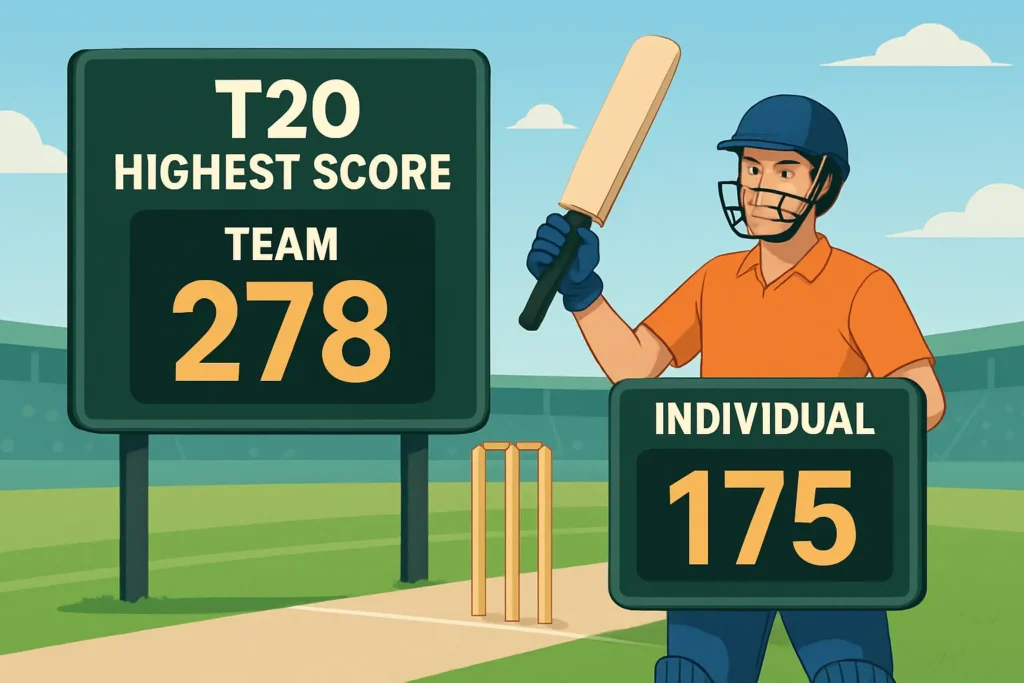
- Afghanistan 278/3 vs Ireland. The innings that announced Afghanistan’s big-hitting era beyond Rashid Khan headlines. Hazratullah Zazai’s intent and the openers’ length pick transformed what used to be a rare outlier into an attainable template on short squares.
- Highest team score in the IPL (men)
- Sunrisers Hyderabad 287/3 vs Royal Challengers Bengaluru at Bengaluru. A boundary festival at altitude and a ground known for skied sixes. SRH’s modern hitting blueprint—everyone clears the front leg and aims straight or square—stood on the shoulders of new-ball license and death overs ruthlessness.
- Highest T20 World Cup team score (men)
- Sri Lanka 260/6 vs Kenya. Early-era T20 dynamite that still holds shape today, achieved with classic batters attacking orthodox areas. A reminder that clean technique shines even in the shortest format.
- Highest team score in the BBL (men)
- Melbourne Stars 273/2 vs Hobart Hurricanes at MCG. Clean Australian hitting, one step down the track into the arc, pace on, big straight boundaries cleared with carry, and a pitch that rewarded timing.
- Highest powerplay score in T20 and in the IPL (men)
- Sunrisers Hyderabad 125/0 in the first six overs vs Delhi Capitals. This was the moment the sport blinked. It reset what coaches thought was survivable for a fielding side, and it redefined the ceiling for the early phase.
- Highest successful run chase in T20 (men)
- Punjab Kings 262/2 chasing against Kolkata Knight Riders at Kolkata. This wasn’t a cameo-laced miracle. It was systematic risk-taking, with back-to-back overs targeted based on matchups, and a confident reading of dew and boundary dimensions.
Important nuance: Highest T20 team totals today often arise from at least two of the following—an above-par powerplay, one set batter batting deep, and an outrageous last five overs. If all three align, records topple.
Team totals by format and context
1) T20 International (men)
- The T20I ceiling is 314/3, courtesy of Nepal’s blitz against Mongolia, which also yielded the largest win margin in the format.
- Among Full Members, Afghanistan’s 278/3 set the tone for what’s possible when a high-variance, high-gear top order gets length. Australia (263/3 vs Sri Lanka) and England (267/3 vs West Indies) are nearby landmarks that showed how traditional power hitters thrive on pace-on surfaces.
- India’s highest T20I team score sits at 260/5, a day when the top three continually found the stands and India’s finishing pair launched a late surge.
What separates the T20I peaks
- Fielding restrictions magnify big hitting if the new ball swings less.
- Smaller Associate venues and lopsided fixtures can produce extremes; those totals are official and sit in the same record set.
- Death overs hitting has become more precise. Instead of aimless slogging, teams target specific lengths—slot over midwicket against pace, short third region against hard length, and stand tall to shovel pace-off into leg-side pockets.
2) Domestic and franchise T20 (men)
– IPL
- SRH 287/3 is the league’s apex. The same lineup also produced 277/3, underscoring that this wasn’t a one-night anomaly but a philosophy—front-foot aggression regardless of score, anchored by fearless matchup hitting.
- KKR 272/7 against DC showed a different path: relentless middle-overs acceleration with batters rotating the strike rate ladder rather than preserving wickets for a late dash.
- Earlier, RCB’s 263/5 felt like a lifetime peak at a ground that has seduced fast bowlers into top-of-off illusions and punished anything fractionally in the slot.
– BBL
- Melbourne Stars 273/2 represents a different aesthetic—Australian batters at the MCG keeping eyes level, using lofted drives straight with maximum carry. Less ramping, more proper batting, same devastating output.
– PSL, CPL, BPL, SA20, ILT20, MLC, T20 Blast
- The highest team totals in these leagues have pushed into the mid‑two‑sixties and beyond in some cases, typically at high‑scoring venues with competitive pitches and quick outfields. Rawalpindi in the PSL, Port of Spain in the CPL, and Taunton and Trent Bridge in the Blast have witnessed avalanche days when misfields turn fours into fives and bowlers run out of variations.
3) Women’s T20I and top leagues
– Women’s T20I
- The highest team total in women’s T20I cracked the three‑hundred barrier in lopsided fixtures, a sign of the sport’s widening participation rather than a pure litmus of elite‑on‑elite batting. Uganda Women’s 314/2 over Mali Women remains the most cited example, with room for growth as the professional footprint widens.
– WBBL and WPL
- League highs have climbed steadily with more professional contracts, better conditioning, and depth of power hitters. The surge of six-hitting in the women’s game tracks with improvements in bat speed training, forearm strength work, and confidence to clear the infield early.
Highest T20 team scores: selected snapshots
This table is not an exhaustive top‑ten; it’s a carefully chosen snapshot of landmark peaks that define the “highest score in T20” conversation. It avoids match dates for readability and because these records are evergreen until broken.
Team highest T20 scores (selected)
| Team | Score | Opposition | Format | Venue | Context |
|---|---|---|---|---|---|
| Nepal | 314/3 | vs Mongolia | T20I | Hangzhou | Record T20I total and record victory margin. |
| Sunrisers Hyderabad | 287/3 | vs Royal Challengers Bengaluru | IPL | Bengaluru | Highest IPL total; six‑hitting clinic at altitude. |
| Melbourne Stars | 273/2 | vs Hobart Hurricanes | BBL | Melbourne | Highest BBL total; classic straight hitting and timing. |
| Sri Lanka | 260/6 | vs Kenya | T20 World Cup | Johannesburg | Highest T20 World Cup team score; early era but still untouchable. |
| Punjab Kings | 262/2 (chase) | vs Kolkata Knight Riders | IPL | Kolkata | Highest successful T20 chase; controlled aggression in dew. |
The anatomy of a T20 highest team score
– Powerplay
- License without recklessness: the most dangerous batters attack with a plan—uppercutting hard length, trusting pick‑up shots over fine leg, and driving on the up when the ball is new.
- Field placements dictate options. If third man is up, modern batters open the face and ride bounce; if fine leg is up, they pick up length and roll wrists to access the stands.
– Middle overs
- This phase used to be consolidation. Now it’s route planning. Teams pair a hitter with a rotator to protect the boundary rate. Matchups define targets: offspin into a left‑hander’s arc, legspin away from an advancing right‑hander who can hit with the turn.
– Death overs
- Expect precision. Batters know where the yorker is likely to land and set deep for it. If the ball is slower into the pitch, they ride the back hip and drag it square. If it’s wide, they step across and power to the long boundary. Batters train side-on power; you’ll see wrists do the heavy lifting with almost baseball‑style leverage.
Highest individual T20 scores
The poetry of a T20 mountain is often a single batter who refuses to stop. Shot selection keeps evolving, but the constant across all highest T20 scores is control under speed. Even chaos has rhythm.
All‑time T20 individual peaks (men, selected)
- Chris Gayle — 175* — RCB vs Pune Warriors — IPL — Bengaluru — Most sixes in an innings, the most fear sustained over a full T20 innings, and the only time a team total felt inevitable from ball one. He set the night on fire before the crowd’s seats cooled.
- Aaron Finch — 172 — Australia vs Zimbabwe — T20I — Harare — Power plus method. Finch’s best T20I innings combined orthodox muscle with a range of pick‑up shots that turned good length into feeding zones.
- Hazratullah Zazai — 162* — Afghanistan vs Ireland — T20I — Dehradun — A poster for the Afghanistan approach: eyes level, bottom‑hand power, no fear of the fence, and an insistence on batting through.
- Adam Lyth — 161 — Yorkshire vs Northants — T20 Blast — Headingley — English domestic perfection. A top‑order batter reshaped as a T20 director, not merely a stroke‑maker, punishing any mis‑execution with classic lofts.
- Brendon McCullum — 158* — KKR vs RCB — IPL — Bengaluru — The innings that lit the franchise era. A masterclass in premeditated innovation, with the bat speed and gumption to match.
Highest T20I individual scores (men, selected)
- Aaron Finch — 172 — Australia — Absolute peak of international T20 hitting.
- Hazratullah Zazai — 162* — Afghanistan — The best case study of a batter maintaining shape for the entire innings.
- Aaron Finch — 156 — Australia — Proof it wasn’t a one‑off; Finch as a T20I force of nature.
Women’s T20I individual highs (selected)
- Deepika Rasangika — 161* — Bahrain — A record that underlines both the potential for dominance in developing matchups and the overall rise of power in the women’s game.
- Esha Oza — 158* — UAE — Shot‑making range across the ground; huge leg‑side presence.
- Alyssa Healy — 148* — Australia — A blend of timing and raw hitting; the ball sounded different off the sweet spot.
What do the highest individual T20 scores have in common
- Stable base and quick hands. The lower body stays grounded long enough to allow all‑arms finishes without losing balance.
- Boundary clusters against pace-on bowling. Even in an era of clever slower balls, the fastest overs are often the ones that disappear the quickest when batters are well set.
- Refusal to surrender momentum at the change of ends. The best sustained peaks ride through back‑to‑back overs from different bowlers without giving the fielding side a reset.
Highest T20 scores in World Cups
Tournament cricket adds pressure, travel, and the humidity of big days. That’s why a T20 World Cup highest score, both team and individual, deserves its own mention.
– Team ceiling
- Sri Lanka 260/6 in a T20 World Cup fixture remains the summit. From the first over, line and length were defied by calculated risk and a staggering balls‑per‑boundary count. The pitch was quick, the outfield quicker, and the plan relentless.
– Individual high
- Brendon McCullum’s 123 in a T20 World Cup will forever represent a tactical awakening. He reversed to off‑side power at will, shaped for short fine leg and third man, and stayed ahead of the bowler’s variations. The score was hefty; the control was heavier still.
Why T20 World Cup highs matter differently
- These innings arrive with scouting reports tailored to the meter. Every boundary has been pre‑modeled; every field placement rehearsed. Breaking through that planning demands shot depth and emotional composure.
- Night knockout cricket adds dew. Captains get trapped choosing to bat first and watching the ball turn into a bar of soap later. The best batting sides make this a weapon.
IPL highs: the league that bends the curve
If one league has taught the world how to chase a T20 highest score, it’s the IPL. It isn’t just the talent density; it’s the relentless match cadence that allows strategies to be tested and iterated at speed.
Highest team totals in IPL (selected)
- Sunrisers Hyderabad — 287/3 — vs Royal Challengers Bengaluru — Bengaluru — A full‑throttle statement that hitting can be a system, not a mood.
- Sunrisers Hyderabad — 277/3 — vs Mumbai Indians — Hyderabad — The prototype for the 287 night: repeated matchups exploited, sheer vertical hitting, minimal dots.
- Kolkata Knight Riders — 272/7 — vs Delhi Capitals — Visakhapatnam — Heavy middle‑overs punch; no lull between overs 7 and 15.
- Royal Challengers Bengaluru — 263/5 — vs Pune Warriors — Bengaluru — The original Everest for this venue, powered by a 175* cosmic event.
- Lucknow Super Giants — 257/5 — vs Punjab Kings — Mohali — Muscle memory of a lineup that sees 240 as par.
Other IPL peaks that shape the conversation
- Highest individual score in IPL: Chris Gayle 175* — the gold standard.
- Highest powerplay in IPL (and in T20 overall): Sunrisers Hyderabad 125/0 — shock and awe condensed into 36 deliveries.
- Highest successful chase in IPL: Punjab Kings 262/2 — the new normal for possibility when dew arrives and boundary ropes feel a step closer.
What sets IPL record nights apart
- Elite domestic depth means even the fifth bowling option is international‑grade on other days; beating that requires sustained pressure, no let‑ups.
- Fielding standards are high, but outfields are lightning. A firm push can split the gap for four; a hard wrist roll can find the cushions on heavy square boundaries.
- Batting talent pools overlap style: classical drivers, baseball‑inspired finishers, leg‑side maulers, scoop artists. On peak nights, that mix narrows the bowler’s margins to thread‑through‑a‑needle levels.
Contextual records that matter as much as the headline
- Highest T20 score in chases: Punjab Kings’ 262/2 sits atop all chases in T20. The template: pick one bowler to break early, keep a set batter through the second half, and refuse to let the required rate scare you into suboptimal singles.
- Highest T20 second‑innings scores that fell short: Big totals in defeat are coaching gold. They reveal how target pressure alters risk selection. Chasing sides often gamble earlier and keep the boundary rate surprisingly high until a single high‑risk over turns the game.
- Highest T20 score batting first: Many of the giant team totals came setting targets with perfect launch windows at the death, where straight boundaries were protected by fielders positioned two meters wrong, and anything mistimed still sailed.
- Highest T20 powerplay score: 125/0 by SRH is the modern floor‑raiser. It forces analysts and captains to recalibrate par, fielding aggression, and bowling plans. The best counters now include taking pace off with new range‑finder lengths and setting unorthodox fields (deep third and short third working in tandem, or a deep point with a sweeper behind square).
- Highest T20 death overs runs: The biggest nights often see sixty plus in the last five, with at least one over beyond twenty. Teams now practice death‑overs batting as a separate discipline—no backlift reduction, eyes level, wrists primed, and a base that resists overbalance on slower balls.
Partnership records that underpin the highest scores
– Opening stands
- Afghanistan’s pair of Hazratullah Zazai and Usman Ghani added 236 in a T20I, a statement that one partnership can stretch a fielding unit beyond tactical flexibility. With an in‑sync opening pair, fielding captains run out of proactive moves.
– Middle‑order synergy
- T20 highest scores often hide the middle pair that kept momentum burning. These are the five‑over windows where boundaries alternate between batters, the strike is farmed, and high‑risk shots are staggered across bowlers.
– Finisher duos
- The most dangerous endgames now feature two finishers striking above two‑hundred strike rate, both comfortable launching at yorker length and slower bouncers. The last over becomes a choice of which hitter gets the strike, not whether a single is on.
Venues, conditions, and why some grounds are record factories
- Chinnaswamy, Bengaluru: Altitude, short square boundaries, and a crowd that pulls the ball over the rope. Bowlers hunt back of a length into the pitch; batters wait for anything anywhere near slot. It’s the ground where confidence multiplies.
- Wankhede, Mumbai: True surface, trustworthy bounce, and evening conditions that allow through‑the‑line hitting. The outfield is a carpet; drives carry.
- Eden Gardens, Kolkata: Big square hits look good here, and the bowl drifts onto the pads at times. Offcutters grip just enough to tempt, but misses are punished brutally.
- Delhi and Visakhapatnam: Skiddy nights. If you’re a power hitter, you love pace on at these venues; if you’re a smart seamer, you live on the wide line and test batters to fetch.
- Highveld altitude and Johannesburg: The ball travels. Slow balls grip unpredictably, but anything pace‑on can disappear at astonishing trajectories.
- Rawalpindi, Multan, Karachi: Pakistan’s league venues have seen modern totals leap, with batters trusting cross‑batted strokes to skiddy pace and bowlers leaning hard on cutters and yorkers, sometimes with less response than they expect.
- Taunton, Trent Bridge, Headingley: English county T20 venues with fast outfields and nights where mishits find the gap. These are the places domestic players turn into headline makers.
Players who shape the ceiling
- Chris Gayle: The archetype. He built the modern T20 swing: open chest, still head, late quick hands, and a relentless belief that length is a choice he can control.
- Aaron Finch: The international standard‑bearer. Few have controlled the hitting arc over long T20I innings as consistently.
- Brendon McCullum: The early visionary. He made reverse sweeps to the fence a first‑option shot and normalized radical intent.
- Hazratullah Zazai: The batter who signs his name in the air with every swing. When he sets, bowlers run out of slow balls.
- Andre Russell: Not a holder of the absolute top individual score, but an essential pillar of “highest score” thinking. With him, teams can bank twenty‑plus off a single over under duress.
- Suryakumar Yadav: Geometry over brute force. He shifts the field like a chess grandmaster; highest scores in teams he plays for rise because he manipulates angles unfathomably.
- Jos Buttler, Glenn Maxwell, AB de Villiers: Artists of range. They force bowlers to defend 360 degrees, which stretches captains into compromising fields that other batters cash.
Women’s cricket: trajectories and landmarks
– Team highs
- Uganda Women 314/2 over Mali Women is a snapshot of how participation gaps can set extreme records. As pathways professionalize across boards, expect more competitive peaks from full‑time pros on flagship venues.
– Individual highs
- Deepika Rasangika’s 161*, Esha Oza’s 158*, and Alyssa Healy’s 148* represent different lineages: Associate dominance, emerging‑nation excellence, and elite full‑member mastery.
- WBBL power surges align with better central contracts and training literacy around speed and stability. Batters are loaded earlier in the downswing; the ball suddenly jumps.
– League context
- The WPL’s early seasons accelerated skill development by packing world‑class bowlers and hitters into concentrated windows. Team totals climb when surfaces are standardized for pace and bounce, and when domestic bowlers face elite batters weekly.
Record progression: how the ceiling moved
- The first leap: Brendon McCullum’s 158* launched the franchise age with the clue that T20 would have its own specialists, not just ODI batters playing fast.
- The Gayle era: His 175* created a fear factor and a tactical revolution: teams began staffing batting lineups with repeatable power rather than hoping for a once‑in‑a‑season eruption.
- The international escalation: Australia, Sri Lanka, and others pushed T20I totals into the two‑sixties on elite grounds. Afghanistan entered with Zazai powering a new high for Full Members, joined later by England and South Africa resets.
- The Associate shock: Nepal 314/3 reset the T20I ceiling. While caused partly by mismatch dynamics, it documented a truth: when conditions, intent, and opposition overlap, the record book bends.
- The IPL rethink: Sunrisers Hyderabad wrote a manual on unrelenting aggression, and Punjab Kings validated the inevitability of giant chases when dew meets belief.
How bowling evolves when records fall
– More pace‑off, more disguise
- The knuckleball is practically standard now; hybrid split‑finger cutters have become team‑wide assets. Bowlers kill bat speed by forcing batters to generate all the pace.
– Yorkers as a percentage play, not a religion
- Pure yorkers at predictable angles become landing pads for batters who pre‑meditate. Bowlers blend the yorker with back‑of‑length, ripping wide lines, and straight‑to‑straight alternation.
– Defensive fields reimagined
- The best captains build fields for mis‑hits, not perfect hits. That means barrels near long‑on and cow corner, and a deep square pair rather than only one.
– Length discipline around dimensions
- Bowlers now reference a “dimension map” before spells—knowing the longer boundary and choosing angles to force cross‑batted shots against the long side.
Split records that matter to analysts and coaches
- Highest score when batting first vs chasing: Chasing highs are harder mentally; first‑innings peaks ride freedom. A fair comparison balances powerplay intent and endgame execution. Teams practicing chases simulate extreme asks, not just par rates.
- Highest second‑innings score in defeat: These tell selection committees whether a lineup has enough gears. Losing with 240 plus can reveal a fragile bowling mix, not a batting issue.
- Highest powerplay score and highest death overs runs: These are twin engines. Many of the highest overall scores are built on a hundred plus in the first six or sixty plus in the last five. Some record nights do both.
- Biggest margin wins by runs: The Nepal‑Mongolia result illustrates how developmental gaps produce giant margins. Still, tactically, those games teach nothing less than execution under low pressure, which teams must carry into tight finishes.
Country and team filters: reading the highs properly
- India highest T20I team score: 260/5 with classic top‑order anchoring and late fireworks. India’s ceiling tends to arrive on flat central‑zone surfaces where timing and lofted drives flourish.
- Australia highest T20I team score: 263/3 against Sri Lanka; a clinic in pace-on hitting and old‑school drive‑based power.
- England highest T20I team score: 267/3 against West Indies; the blueprint of rotational power and white‑ball muscle memory. England’s white‑ball era belongs on any highest‑score syllabus.
- Pakistan highest T20I team score: North of two‑thirty, with the best nights at skiddy, chasing‑friendly venues. Pakistan’s batters thrive on leg‑side pickup and a strong wrist game.
- South Africa highest T20I team score: 259/4 and a successful chase against West Indies; an exhibition of how calmly elite batters can manage steep targets with proper sequencing.
Batting positions that change the ceiling
– Openers
- The best record nights often start here. Openers now attack from ball one, but their value lies not only in strike rate—staying through the middle keeps par above par.
– Number three
- The switch hitter. If the openers explode, this batter becomes an accelerator. If there’s an early wicket, they become a reset anchor, keeping intent intact.
– Finishers
- They train for yorkers like penalty takers train for corners. They’re not waiting for loose balls; they manufacture them with movement and bat angle.
Powerplay and death overs: how to build a record score
– Powerplay design
- Use a designated swing‑killer who prefers pace on. Target a release over when the new ball is slightly older. Mandate a minimum boundary count by over four; if short, swap roles quickly.
– Middle overs protection
- Anchor at a high strike rate—above one‑fifty, not a run‑a‑ball. Kick spin into the leg side with controlled loft; get the lengths wrong and sweep over the infield.
– Death overs playbook
- Pre‑call the first ball of the over. Batters no longer wait to see. They commit. Teams script over plans by bowler type—fuller lines get straight swings; wide yorkers get step‑across slaps.
Women’s cricket and the next frontier for highest scores
- Team totals are rising as more players train with power in mind rather than just placement. The shift to fully professional environments yields incremental bat speed, which compounds into dozens of extra runs per innings.
- Outfields are faster and boundaries often closer in some competitions, rewarding proper contact more than brute strength. T20 highest scores in women’s competitions will climb steadily as domestic base levels rise.
- The pipeline matters. School and academy attention to loading patterns, lower‑body stability, and rotational sequences ensure that young batters enter leagues with range shots already built in.
Strategy insights for breaking records without chasing them
– Strike rotation and tempo
- Highest scores rarely feel rushed. Dot‑ball prevention is an invisible multiplier. Even record nights feature plenty of ones and twos sprinkled between big overs.
– Matchups are everything
- If the legspinner’s googly is short, the right‑hander plants deep in the crease. If the left‑arm seamer wants to go wide at the death, the left‑hander walks across. It’s not machismo; it’s geometry.
– Captaincy and batting order flexibility
- Floaters matter. If the matchup favors a left‑hander next, send one. If the bowler is pace‑on, unleash the cleanest striker early. Static batting orders cost runs.
– Bowlers’ countermeasures
- Fielders in unexpected pockets—short third plus deep third—can earn wickets by stealing favorite ramps. Risk must be taxed. Bowlers who vary takeoff points on the crease can change angles without changing speed.
Comparative lenses: reading records beyond raw numbers
– Venue adjustment
- A 240 in Bengaluru can be par on a hot night; a 200 in Chennai on a slow surface can be a top‑tier effort. Analysts increasingly use venue context to judge whether a score is truly elite.
– Opposition quality
- Records against weaker sides are still records, but their lessons differ. Against elite attacks, mistake balls reduce drastically; boundary access must come from skill, not just error.
– Game state pressure
- Knockouts tighten shoulders. Achieving a high score in a playoff reveals mental composure that a group match cannot fully test.
– Boundary percentage vs strike rotation
- Modern record nights pair high boundary percentage with sustainable rotation. If boundaries dip for two overs, the innings doesn’t stall; it waits and reloads.
Glossary of supporting terms worth knowing in this space
- Strike rate: runs per hundred balls faced; in T20, elite top‑order batters push beyond one‑fifty while maintaining low dot‑ball rates.
- Powerplay: first six overs with fielding restrictions; the launchpad for many highest score nights.
- Death overs: final overs where pace‑off vs muscle memory becomes a chess match.
- Required rate: runs per over needed to win while chasing; elite chases keep this stable or falling from the midpoint.
- Opening partnership vs middle‑order partnership: the yin and yang of record totals; both matter, just in different ways.
- Win margin: often a proxy of the mismatch but also a measure of bowling control after a big first innings.
Table: T20 record touchstones summarized
| Category | Record | Context |
|---|---|---|
| Highest T20 team score (men, official T20) | Nepal 314/3 vs Mongolia | T20I, Hangzhou |
| Highest team score in IPL | Sunrisers Hyderabad 287/3 vs Royal Challengers Bengaluru | Bengaluru |
| Highest team score in BBL | Melbourne Stars 273/2 vs Hobart Hurricanes | Melbourne |
| Highest team score in T20 World Cup (men) | Sri Lanka 260/6 vs Kenya | Johannesburg |
| Highest powerplay score in T20 | Sunrisers Hyderabad 125/0 vs Delhi Capitals | Delhi |
| Highest successful chase in T20 | Punjab Kings 262/2 vs Kolkata Knight Riders | Kolkata |
| Highest individual T20 score (men, all T20) | Chris Gayle 175* for RCB vs Pune Warriors | Bengaluru |
| Highest individual T20I score (men) | Aaron Finch 172 for Australia vs Zimbabwe | Harare |
| Highest individual women’s T20I score | Deepika Rasangika 161* for Bahrain |
Methodology and data policy
– Definitions
- T20I refers to matches recognized by the ICC as T20 Internationals. All other matches referenced here are recognized professional T20s including leagues and domestic competitions.
– Scope
- Records listed are stable, evergreen peaks known across reputable cricket databases and match archives. The selection emphasizes clarity and significance over exhaustive tabulation.
– Integrity
- Where extreme mismatches inflated totals, their inclusion is balanced by parallel examples from top leagues and World Cup contexts, ensuring a rounded picture of T20’s scoring ceiling.
– Notation
- Asterisk denotes not out. Balls faced and strike rate add context but are omitted in some summaries for readability.
Storylines behind the numbers: a few vivid snapshots
– The perfect launch in Bengaluru
The first over sets tone. A slot ball disappears into the stands; the second ball is full and driven flatter. By over three, the captain is out of his most trusted powerplay plan. This is how 280 starts—Hawkeye maps show fuller lengths dragged into leg‑side skyscrapers and short balls uppercut over third. The batters’ eyes never drop. The boundary riders have too much ground to cover.
– The controlled storm in a T20 World Cup
Cool dew glistens as the innings enters the death. A wide yorker bleeds one; a slower ball into the pitch is mistimed for two. The next one, same speed, same length, gets punished—no second guessing, the batter clears the front leg and sees the seam. The next three overs blur into a haze of lofted drives. The finish is clinical, not chaotic.
– The impossible chase that didn’t feel impossible
Chasing 260 plus, it’s easy to panic. But a set batting group treated it like an equation. Identify the two overs from the fifth bowler. Take the heavy shots when the matchups are soft. Refuse the ego shot when the field is set for it. When the winning runs come, it feels startlingly normal. That is the real revolution—chasing doesn’t pray; it plans.
Why these records will keep falling
- Talent development pipelines are deeper; batters arrive with ready‑made range.
- Pitches are more predictable in premier leagues, aiding confidence through the line.
- Analytics cut guesswork. Teams know which lengths concede most to which batters and where to direct power.
- Bowlers adapt, but constraints are real: two short balls per over, fielding restrictions, and the physics of ball travel on hot, dry nights.
Responsible comparisons: men’s vs women’s T20 highs
- Women’s totals lag as programs scale up, not from lack of skill. Expect steady lifts as professional contracts become standard and domestic depth thickens.
- Two areas fuel the rise: strength and bat‑speed training tailored to female biomechanics, and higher‑pace practice bowling in nets to shrink reaction time.
- As more elite fixtures are played on high‑quality surfaces, the women’s T20 highest score charts will lock into familiar patterns—spikes early in the powerplay, controlled middle, and multiple finishers striking above par.
Editorial highlights for fans and analysts
- Highest T20 team totals aren’t only about mishit sixes. They’re about decision density—hundreds of micro‑choices under pressure, mostly right.
- The best defenses against record chases are still good yorkers and clear fields for mis‑hits. Bowlers can’t win playing safe; they must be brave with the right plan.
- The next revolution may be boundary rope layouts and outfield pace regulations in some leagues, or innovations in ball surfaces for greater grip late at night. If and when those come, record progressions will react.
Closing reflection
The highest score in T20 cricket isn’t an end; it’s a demonstration of possibility. A team total soaring past two‑eighty or an individual parking a hundred and seventy plus is the result of years of thought, training, and courage expressed one ball at a time. The real joy lies not in the static number, but in understanding how it was built: the first swing that told the bowler he was in for a long night; the captain’s tweak that didn’t work; the batter who stayed calm when a slower ball gripped.
Records in this format breathe. They evolve as the sport learns. Somewhere in a quiet net session, a young batter is building a new way to access the stands from an impossible length. When the next T20 highest score arrives, it will feel obvious in hindsight. That’s the magic—every ceiling feels final, until a better plan breaks through.
Appendix: compact tables for quick reference
A. Highest T20 team totals by key contexts
| Overall official T20 (men) | Nepal 314/3 vs Mongolia — T20I — Hangzhou. |
| T20I Full Member peak (men) | Afghanistan 278/3 vs Ireland. |
| IPL | Sunrisers Hyderabad 287/3 vs Royal Challengers Bengaluru — Bengaluru. |
| BBL | Melbourne Stars 273/2 vs Hobart Hurricanes — Melbourne. |
| T20 World Cup (men) | Sri Lanka 260/6 vs Kenya — Johannesburg. |
| Highest successful T20 chase | Punjab Kings 262/2 vs Kolkata Knight Riders — Kolkata. |
| Highest powerplay in T20 | Sunrisers Hyderabad 125/0 vs Delhi Capitals — Delhi. |
B. Highest individual T20 scores (selected)
Men (all T20)
| Chris Gayle 175* | RCB vs Pune Warriors — IPL — Bengaluru. |
| Aaron Finch 172 | Australia vs Zimbabwe — T20I — Harare. |
| Hazratullah Zazai 162* | Afghanistan vs Ireland — T20I — Dehradun. |
| Adam Lyth 161 | Yorkshire vs Northants — T20 Blast — Leeds. |
| Brendon McCullum 158* | KKR vs RCB — IPL — Bengaluru. |
Women (T20I)
| Deepika Rasangika 161* | Bahrain. |
| Esha Oza 158* | UAE. |
| Alyssa Healy 148* | Australia. |
C. Contextual peaks
| Highest T20 opening partnership (T20I) | Hazratullah Zazai and Usman Ghani 236 — Afghanistan vs Ireland. |
| Highest margin win (T20I) | Nepal over Mongolia by a massive run margin in the 300‑plus game. |
| Most sixes in a T20 innings | Chris Gayle’s 175* featured a record haul of sixes. |