
See how many countries play cricket today. Up-to-date ICC totals, Full vs Associate, Test/ODI/T20I breakdown, full regional view + expert insights.
How Many Countries Play Cricket? [Updated this month]
Quick answer
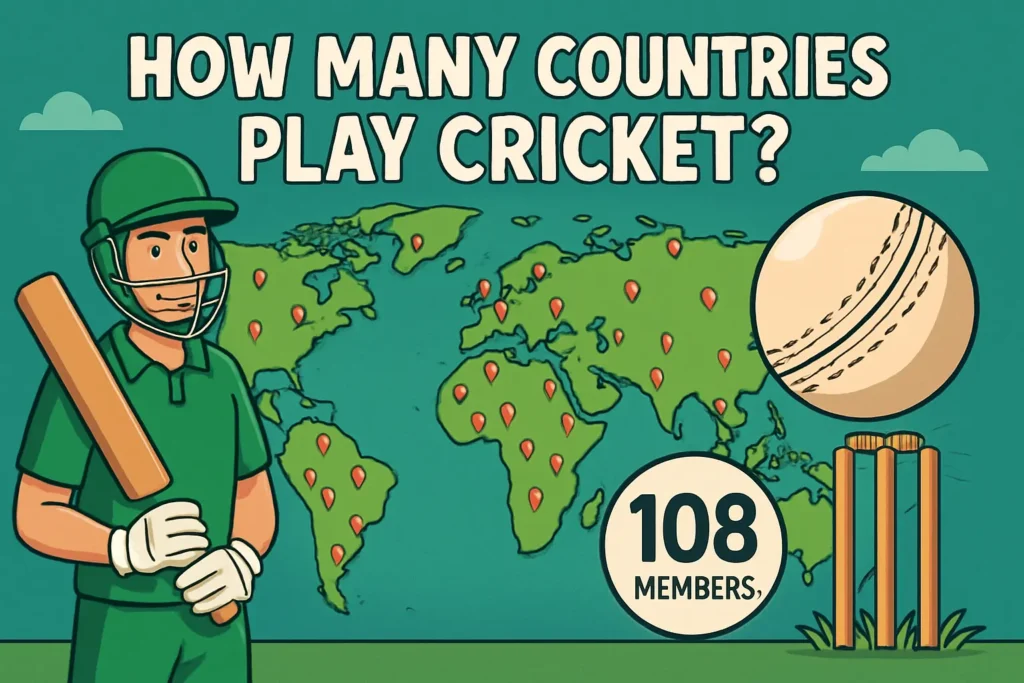
As of today, the International Cricket Council (ICC) recognizes 108 member countries: 12 Full Members (Test nations) and 96 Associate Members. All ICC members are eligible to play official T20 internationals. Source: ICC.
Before we go further, let’s define exactly what “play cricket” means
The headline number trips a lot of people up because cricket exists on multiple overlapping planes: international, regional, domestic, and recreational. When someone asks “how many countries play cricket in the world,” they might be thinking of any one of these layers. Here’s the cleanest way to think about it:
- ICC members: These are national governing bodies recognized by the ICC. This is the authoritative count of cricket-playing countries in an official sense. Today that number is 108.
- Full Members: The twelve countries with Test status. Their men’s teams play Test, ODI, and T20I cricket; their women’s sides play ODIs and T20Is (women’s Tests exist but are not a status category for membership).
- Associate Members: Ninety-six countries recognized by the ICC that compete in ICC pathway events and can play T20Is. Some also hold ODI status based on on-field results.
- ODI status vs T20I status: Every ICC member has T20I status in the men’s and women’s game. ODI status is limited to Full Members plus a small number of top Associates determined by ICC competitions.
- Non-ICC national teams: A handful of territories and microstates field representative sides in friendlies, regional cups, or indoor tournaments but aren’t ICC members. Their matches aren’t official internationals.
One more crucial nuance: West Indies is not one country. The West Indies men’s and women’s teams represent a federation of cricket boards spanning multiple sovereign states and territories in the Caribbean. It’s a glorious quirk of the sport and a constant source of confusion for casual fans.
What “counts” for different formats today
- Test cricket: 12 countries. Only ICC Full Members play men’s Test matches.
- ODI cricket: 20 countries right now, made up of 12 Full Members plus 8 Associates with ODI status based on recent qualification pathways.
- T20I cricket: 108 countries are eligible because every ICC member nation’s T20 match against another ICC member is an official T20 international (the same principle applies in the women’s game).
These three numbers are often conflated. The big myth is that “Test nations = all countries that play cricket,” which sells the sport short by dozens of nations that are thriving in T20Is and in ICC pathway competitions.
ICC Full Members (Test nations)
These are the teams that carry the longest format and much of the sport’s institutional weight. For context and clarity, here’s the complete list, with a line of lived context an expert would add if we were talking in a press box.
- Afghanistan — The fastest risers of the modern era; a pipeline of spinners developed on matting and hard surfaces, supported by an obsession with the game that spills into every alleyway where tape-ball rules.
- Australia — A pace-bowling factory with domestic pathways that reward pace, fitness, and relentless length; the Sheffield Shield remains one of the toughest proving grounds in cricket.
- Bangladesh — Passion without a ceiling and a domestic system that’s finally exporting confidence abroad; their young quicks have begun to shape the story, not just their spinners.
- England — The birthplace of the sport and still a laboratory for reinvention; county cricket and The Hundred coexist uneasily but have broadened the talent pool.
- India — The gravitational center of the global game; an unmatched domestic structure (Ranji, Duleep, IPL) and a fan base that pushes standards — and revenues — higher every season.
- Ireland — A generation forged in English domestic cricket carried them to the big table; the next step is deepening the first-class system at home.
- New Zealand — Small population, giant efficiency; a culture of skill development and specific plans for specific conditions, turbo-charged by smart selection.
- Pakistan — The unpredictability is real, but so is the conveyor belt of bowlers who can do things others cannot; street cricket and tape-ball shape gifts that academies learn to refine.
- South Africa — Athleticism and technique honed on hard, fast wickets; the school system is a production line, the franchise era adds fresh competition for players’ time.
- Sri Lanka — A tradition of unorthodox genius; finger-spinners with carrom-ball tricks and batters schooled on low, slow pitches that test temperament.
- West Indies — Joy and flair born of multiple nations under one maroon cap; raw pace once defined them, T20 leagues now shape much of their calendar.
- Zimbabwe — A proud Test heritage rebuilding its base; recent youth results suggest green shoots.
ICC Associate Members: the spine of global growth
Ninety-six ICC Associate Members make up the most misunderstood and most exciting part of cricket’s map. Some are well-known: Netherlands, Scotland, Nepal, UAE, USA, Oman, Namibia, and Canada compete with and beat Full Members with increasing regularity. Others are newer or more regional in focus, from Uzbekistan and Cambodia in Asia to Luxembourg and Switzerland in Europe, to Côte d’Ivoire in Africa.
A few realities worth stating bluntly:
- Associate standards are rising fast. Fitness, fielding, and power-hitting have closed the gap in white-ball cricket.
- Home crowds outside the big twelve can be ferocious. If you’ve been at Tribhuvan in Kathmandu on a packed day, you know what a wall of sound from a so-called “minor” cricket nation really feels like.
- Facilities are multiplying. Hybrid wickets, modular pavilions, and floodlights funded by municipal partnerships have unlocked more matchdays and more practice time than any single coaching tweak ever could.
Format status: Test, ODI, T20I in plain English
Because status questions dominate search results, here’s a quick, plain-language guide to “how many countries play” each format, and what that actually means on the field.
- Test cricket (12 teams): Only Full Members play Tests. There is no separate Test status outside Full Membership. Associates can play multi-day first-class cricket domestically and in ICC regional first-class competitions, but those aren’t Tests.
- ODI cricket (20 teams): Full Members automatically have ODI status. A select group of Associates earn ODI status via ICC qualification pathways. Right now the Associates with ODI status include Netherlands, Scotland, Namibia, Nepal, Oman, USA, UAE, and Canada.
- T20I cricket (108 teams eligible): Every ICC member nation is eligible to play official men’s and women’s T20 internationals against other members. This policy turned global T20s into a truly open international ecosystem, allowing rankings, caps, and records to accrue across the full membership.
Women’s national teams and age-group pathways
A number that rarely makes the headline but should: every ICC member is eligible to field a women’s national team with WT20I status. Not every member has an active women’s program yet, but more than half do, and the number climbs each season.
- Thailand’s women set the modern template for a rapid rise: crisp fielding, metronomic bowling, and unbelievable discipline. Their success in global qualifiers changed minds across Asia.
- Brazil handed central contracts to women before the men — a landmark decision that sent a message across the Americas about where the sport could grow first.
- Rwanda’s girls qualifying for a global U19 event delivered a spark for the entire African pathway; that team’s composure under lights made believers of anyone watching.
- Indonesia’s junior women produced some of the most technically compact batters at youth level — proof that coaching detail matters more than a long history.
Age-group cricket (U19) is the oxygen of growth. For newer members, U19 Tours and ICC regional qualifiers deliver the volume of meaningful matches needed to make practice stick. When you see an Associate batter calmly manage a chase on a slow pitch, you’re often watching the residue of a dozen U19 games that taught them how to nudge and run, not just swing hard.
Regional breakdown: where cricket lives and where it’s surging
The ICC organizes the world into five regions: Asia, Europe, Africa, the Americas, and East Asia-Pacific (EAP). Each has its own rhythm, its own seasonality, and its own highways of migration that shape how the game develops.
Asia
- Full Members: Afghanistan, Bangladesh, India, Pakistan, Sri Lanka.
- Associates of note: Nepal, UAE, Oman, Qatar, Bahrain, Saudi Arabia, Kuwait, Malaysia, Thailand, Singapore, Hong Kong, Cambodia, Uzbekistan, Mongolia, Maldives, Bhutan, Iran.
What a practitioner sees: Immense depth. South Asian diasporas feed domestic leagues from Dubai to Kuala Lumpur. Nepal’s home atmosphere is as intense as anywhere. Oman runs ICC events with a calm professionalism that belies the desert. Thailand’s women built a standard others in the region now chase. Mongolia and Uzbekistan represent the sport’s newest frontier in the high steppe and Central Asia. The Gulf’s expat-driven leagues produce players used to high-intensity T20 schedules, and — crucially — a culture of organized cricket under lights.
Europe
- Full Members: England, Ireland.
- Associates of note: Netherlands, Scotland, Germany, Italy, Spain, Jersey, Guernsey, Norway, Sweden, Denmark, Finland, Austria, Belgium, Greece, Portugal, Czech Republic, Hungary, Luxembourg, Switzerland, Romania, Serbia, Croatia, Malta, Gibraltar, Cyprus, Isle of Man.
What a practitioner sees: Indoor cricket in winter; weekend leagues that stretch daylight; an explosion of clubs formed by South Asian and African communities merging with local enthusiasts. Germany’s men now regularly produce bowlers who hit the deck hard at a strong pace; Spain and Italy draw crowds on coastal grounds; the Netherlands have built a professional core that wins big games in ICC events. Switzerland returned to the ICC fold and is investing in youth; the Isle of Man and Jersey prove that small populations can still deliver national systems that function like clockwork.
Africa
- Full Members: South Africa, Zimbabwe.
- Associates of note: Namibia, Kenya, Uganda, Nigeria, Tanzania, Rwanda, Botswana, Malawi, Mozambique, Sierra Leone, Ghana, Cameroon, Côte d’Ivoire, Eswatini, Lesotho, Gambia.
What a practitioner sees: Raw athleticism and relentless fielding. Namibia’s white-ball discipline is a model for Associates everywhere. Uganda’s surge in T20Is comes from doing the basics at high speed. Kenya’s proud history still inspires; Nigeria’s youth base is larger than most realize. Rwanda’s administrative professionalism — including a strong women’s program — is turning them into a regional hub for tournaments.
Americas
- Full Members: None.
- Associates of note: USA, Canada, Bermuda, Cayman Islands, Bahamas, Argentina, Brazil, Chile, Mexico, Panama, Belize, Suriname.
What a practitioner sees: The USA co-hosted a global T20 event and now has a birthing top-flight franchise league with serious stadium infrastructure. Canada regained ODI status and fields a balanced side. Bermuda’s cricket tradition runs deep; Brazil and Argentina are writing their own modern path, with women’s cricket often leading the way. In the Caribbean, smaller territories not included within West Indies structures still compete vigorously at regional level; the cultural reach of the game is unmatched in island communities.
East Asia-Pacific (EAP)
- Full Members: Australia, New Zealand.
- Associates of note: Papua New Guinea, Philippines, Indonesia, Japan, Vanuatu, Fiji, Samoa, Cook Islands.
What a practitioner sees: PNG’s “Barramundis” play a joyous brand of cricket with fearless intent. Japan’s youth systems — particularly in schools — produce smart cricketers used to repeatable skill work. Indonesia’s women, especially at junior level, have stunned more established teams with their technique and composure. Vanuatu runs some of the most community-centered programs anywhere; their domestic competitions are a masterclass in how to build participation around volunteers and shared fields.
How many countries have national cricket teams?
If by “national cricket teams” we mean ICC-recognized senior sides capable of playing official internationals, the answer is 108 for men’s T20Is and an eligible 108 for women’s T20Is. Not every member has a women’s team taking the field yet, but the eligibility is there and the curve is up.
If we include non-ICC teams that play regional friendlies, indoor internationals, or cross-border festivals, the number nudges higher. Think Monaco’s representative side playing charity fixtures, the Vatican XI engaging in interfaith tours, or territories with emerging federations not yet aligned with the ICC. These are wonderful stories, but they sit outside the official international framework that records caps, rankings, and statistics.
What about competitions — who actually plays?
- Test cricket: 12 nations.
- ODIs: 20 nations — 12 Full Members plus 8 Associates (Netherlands, Scotland, Namibia, Nepal, Oman, USA, UAE, Canada).
- T20Is: Eligible pool of 108 nations.
- Women’s T20Is: Eligible pool of 108; the number actively competing grows each cycle.
In the most recent T20 World Cup, the expanded field included twenty teams: West Indies and USA as co-hosts, plus India, Pakistan, England, Australia, South Africa, New Zealand, Sri Lanka, Bangladesh, Afghanistan, Ireland, Scotland, Netherlands, Namibia, Nepal, Oman, Papua New Guinea, Uganda, and Canada. That event changed a lot of assumptions, particularly around North America’s appetite for the game and the on-field competitiveness of “newer” teams such as Uganda.
Why not every country plays cricket (yet)
Even with 108 ICC members, there are obvious gaps on the map. The reasons are practical, not philosophical.
- Climate and facilities: Cricket needs space, flat ground, and a lot of dry time. Indoor cricket helps, but the sport still blooms fastest where you can play outdoors regularly.
- Competing sports ecosystems: In some countries, football, basketball, rugby, or baseball monopolize school programs and municipal grounds. It takes either a diaspora push or a visionary administrator to carve out space for cricket.
- Equipment and coaching: Good cricket balls are expensive; coaching manuals are not universal. Nations that share a language with established cricket bodies adopt faster.
- Media visibility: Where people can watch the IPL, the Ashes, the PSL, the BBL, or the Hundred on their phones, clubs sprout. Where rights are hard to access, growth drags.
The evolution of membership and status: what changed and why it matters
A few structural changes across recent cycles have accelerated growth and cleaned up the international record books.
- “Affiliate” status discontinued: The ICC simplified membership categories, leaving only Full and Associate Members. This made governance cleaner and clarified development pathways.
- Universal T20I status: The ICC granted full T20 international status to all member-versus-member T20s in both the men’s and women’s game. Suddenly, a T20 in Buenos Aires, Almaty, or Kigali counted as much, in status terms, as one in Melbourne or London. This has been the single biggest driver of recognizability for newer teams.
- ODI status tied to performance: Rather than fixed, immutable lists, ODI status for Associates is now earned through pathway performance and can change. That keeps the ecosystem honest and the stakes high for every qualifier.
- Additions and suspensions: The membership list isn’t static. New members have been admitted from Central Asia and Southeast Asia; one notable European nation was re-admitted; disciplinary suspensions have hit governance-troubled boards; and a major expulsion in Eastern Europe followed non-compliance. Cricket’s governance is active, not ceremonial.
- Temporary suspensions for Full Members: Even historic boards are not immune when governance strays from ICC standards. Short suspensions have been imposed and lifted when compliance returned.
How the West Indies fit into “how many countries play cricket”
The West Indies men’s and women’s teams represent multiple sovereign nations and territories across the Caribbean, such as Jamaica, Trinidad and Tobago, Barbados, Guyana, Antigua and Barbuda, Saint Lucia, and others. In ICC accounting, the West Indies count as one Full Member team. Domestically, these islands maintain their own boards and field separate teams in regional competitions like the Four-Day Championship and the Super50 Cup. If you’ve ever sat on the grassy banks in Antigua while a Trini quick sprints in at a Bajan opener, you understand: it is one team internationally, but a federation of fierce local identities underneath.
Cricket in Europe, Africa, Asia, the Americas, and EAP — who actually plays on weekends
It’s easy to talk in initials and membership statuses; it’s more honest to talk about actual cricket.
- Europe: On a summer weekend in Hamburg, you can bounce between three grounds along the same train line and see fixtures from Division 5 up to the Bundesliga tiers. In Rome, a T20 league starts early to beat the heat; in Madrid, evening games pull in crowds who’ve just gotten off work. The Netherlands host touring Full Members and win more often than outsiders expect.
- Africa: Kampala’s afternoon cloudbursts don’t stop Uganda’s men from bowling high-pace powerplays. Nairobi still produces batters with elegant back-foot games. In Kigali, a women’s T20 double-header fills the same oval that, just hours earlier, hosted a junior festival of cricket.
- Asia: The Gulf runs games into the night. Singapore’s small grounds produce high-scoring shootouts that test nerve as much as skill. In Nepal, fans arrive hours early, winding around the stadium in red and blue; the atmosphere is a force multiplier.
- Americas: Florida’s grounds are packed for festival weekends; in Texas and North Carolina, serious money has built serious wickets. Toronto’s community leagues stubbornly play through cold springs to grab every weekend possible. In São Paulo, Brazil’s central contracts for women changed how clubs recruit and train girls.
- EAP: Port Moresby turns out for the Barramundis, and the fielding is a clinic. In Tokyo, schoolboys shadow-bat in corridors; in Bali and Jakarta, academies produce batters with repeatable, old-school techniques that would make any classical coach smile.
The ODI Associates: why this group matters
Repeat their names when someone asks whether “only a few countries play cricket”:
- Netherlands — A disciplined white-ball unit with seamers who use wobble seam on sluggish pitches and batters happy to find gaps for ones and twos. They have a habit of upsetting the order at big events.
- Scotland — Set-piece bowlers who know exactly what to do with new or old balls, and a batting lineup unafraid to take the inside-out loft early in the innings.
- Namibia — Calm in chases, sharp in ring fielding, and a coaching culture that emphasizes decision-making under pressure.
- Nepal — A crowd-fueled side that rides momentum; spinners who relish responsibility; batters who embrace the slog-sweep as a legitimate scoring option, not just a release shot.
- Oman — Metronomic with the ball and relentlessly tidy. Winning in heat teaches discipline the colder nations envy.
- USA — A batting core powered by domestic franchise competition, with pace coming through as facilities improve. Co-hosting a global event has shifted public perception quickly.
- UAE — Professionalism honed by high volumes of cricket; a batting order that’s deep, even if the public doesn’t know the names yet.
- Canada — A proud program reborn with ODI status; bowlers who use the seam skillfully on drop-in and hybrid wickets.
Pathway from Associate to Full Member
The ICC doesn’t hand out Full Membership lightly. The pathway is a mixture of:
- On-field performance across formats and qualifiers.
- Sustainable domestic structures (men and women, senior and junior).
- Governance and financial compliance that can stand scrutiny.
- Facilities capable of hosting top-tier international cricket.
A realistic path looks like this: earn and retain ODI status, compete strongly in global qualifiers, host international cricket, build first-class and List A domestic competitions, grow women’s and youth pathways, and demonstrate robust governance. Ireland and Afghanistan are the modern case studies. Both built domestic seriousness and then proved it over and over in global events until the weight of evidence was unanswerable.
The franchise era and global growth
Leagues have redrawn the cricket map as much as any ICC policy.
- Major franchise hubs: IPL, BBL, PSL, CPL, SA20, ILT20, The Hundred, BPL, and others. Each has expanded the audience and created models for player pathways.
- New frontiers: Major League Cricket in the USA has already increased training volumes and attracted overseas professionals who become player-coaches, raising local standards. The Gulf’s franchise circuits create year-round cricket economies that Associates plug into.
- Upskill effect: Associates now train with and against Full Member stars regularly. It shows up in improved fielding standards and aggressive batting intent.
Olympic push
T20’s inclusion in the upcoming Los Angeles Games changes conversations with governments. Olympic recognition unlocks funding in many countries; it also gives administrators a lever with schools and universities that previously looked past cricket. Expect more indoor centers, more municipal grounds adapted for cricket, and more scholarship pathways for young players — especially women.
Countries where cricket is popular vs where it’s still growing
- Popular to the core: India, Pakistan, Bangladesh, Sri Lanka, England, Australia, South Africa, New Zealand, Afghanistan.
- Popular and rising: Nepal, Netherlands, Scotland, USA, UAE, Oman, Namibia.
- Rapid growth hubs: Germany, Italy, Spain, Japan, Indonesia, Thailand, Rwanda, Brazil.
- Early-stage or niche: Much of Central Asia beyond the early adopters; parts of Eastern Europe; several Latin American nations where cricket is still primarily expatriate-driven but increasingly open to local youth.
A small but important clarification: popularity is not only measured in TV ratings. It’s measured in clubs per square mile, junior teams per ground, and the number of evenings you drive past floodlit nets full of teenagers wearing mismatched pads and smiling anyway.
Suspensions, expulsions, and reinstatements: a plain-english changelog
Membership shifts do occur. Governing bodies can be suspended for government interference or compliance failures; suspensions are lifted when standards are met. Some Associates have been suspended for not meeting participation or governance requirements; a European nation returned to the fold after administrative issues were resolved; an Eastern European member was expelled following prolonged non-compliance; a southern African board had a temporary suspension lifted after governance fixes; a South Asian member with massive crowds once faced a suspension that was later reversed; a major Asian Full Member experienced a short suspension that was lifted after corrective steps.
No one likes these episodes, but they matter because they protect the integrity of international competition and development funding.
A CSV-ready summary you can copy
For quick reference or your own analysis, here’s a copy-friendly snapshot.
ICC Membership & Status Overview
| Category | Count | Notes |
|---|---|---|
| ICC Members | 108 | All eligible for men’s and women’s T20I |
| Full Members | 12 | All play men’s Tests; women play ODIs and T20Is |
| Associate Members | 96 | Compete in ICC pathways; all T20I-eligible |
| ODI Nations | 20 | 12 Full + 8 Associates (NED,SCO,NAM,NEP,OMA,USA,UAE,CAN) |
| T20I-eligible Nations | 108 | Universal T20I status for ICC members |
ICC Full Members
| Full Members (by name) | Region | Status |
|---|---|---|
| Afghanistan | Asia | Full Member (Tests, ODIs, T20Is) |
| Australia | EAP | Full Member (Tests, ODIs, T20Is) |
| Bangladesh | Asia | Full Member (Tests, ODIs, T20Is) |
| England | Europe | Full Member (Tests, ODIs, T20Is) |
| India | Asia | Full Member (Tests, ODIs, T20Is) |
| Ireland | Europe | Full Member (Tests, ODIs, T20Is) |
| New Zealand | EAP | Full Member (Tests, ODIs, T20Is) |
| Pakistan | Asia | Full Member (Tests, ODIs, T20Is) |
| South Africa | Africa | Full Member (Tests, ODIs, T20Is) |
| Sri Lanka | Asia | Full Member (Tests, ODIs, T20Is) |
| West Indies | Americas/Caribbean | Full Member (Tests, ODIs, T20Is) |
| Zimbabwe | Africa | Full Member (Tests, ODIs, T20Is) |
Notable Non-ICC Teams (Informal)
| Notable non-ICC teams (informal) | Status | Notes |
|---|---|---|
| Monaco | Non-ICC | Representative fixtures and festivals |
| Vatican | Non-ICC | Interfaith tours and friendlies |
| Others | various | Occasional cross-border friendlies; not ICC-recognized |
How many countries play domestic cricket but are not in the ICC?
Plenty of territories host regular domestic or recreational cricket without ICC membership. In Europe alone, you’ll find small federations arranging friendlies, indoor tournaments, and social leagues while they work toward ICC criteria: constitutional governance, minimum participation numbers, proper accounting, and consistent fixture calendars. The figure waxes and wanes as groups formalize or merge. Crucially, none of their matches count as official internationals until membership is achieved, but that doesn’t make their cricket any less real to the people who turn up every weekend.
Test vs ODI vs T20I: why the split matters for development
- Tests demand deep first-class structures and four-day cricket at home. Associates without first-class culture can compete in limited-overs formats but need time and money to build multi-day pathways.
- ODIs are a bridge. Fifty-over cricket teaches innings management, fielding discipline across 300 legal balls, and the mental toughness needed for big tournaments. ODI status is a development accelerator.
- T20Is democratize the game. They require less infrastructure, fit urban schedules, and travel well. Associates who focus on T20 can get good, fast — and they are.
Behind-the-scenes truths only insiders say out loud
- The toss matters less than the dew. A modest Associate batting first on a dewy night can lose 20 runs of fielding value after the break.
- The best Associates invest in wicketkeepers. Half-chances become wickets; wides disappear. That’s a 15-run swing most fans don’t notice.
- Indoor winter nets in Europe might be the single biggest hidden factor in the region’s rise; repetition created muscle-memory that shows up in T20 crunch overs.
- Outfields in developing programs are often slower; the best batters learn to hit over rather than through. Watch their lofted drives — they’re deliberate, not rash.
- Tape-ball isn’t a gimmick. It teaches late swing control and unconventional strokeplay; coaches who embrace it tend to unlock hidden skills, especially in kids.
Cricket by population and GDP: a different way to think about reach
- High-population powerhouses naturally dominate viewership and player numbers. But per-capita enthusiasm in places like New Zealand, Ireland, Namibia, and Scotland is astonishing.
- Wealth doesn’t guarantee excellence; it guarantees facilities. Cricket culture must still be built. The USA’s trajectory proves money helps, but coherent pathways and clear selection policies are non-negotiable.
- The biggest “market” story today is not a country; it’s the diaspora. South Asian communities have seeded cricket clubs from Vancouver to Vienna to Valencia.
Women’s cricket: how many teams and where the surge is strongest
Every ICC member can play WT20Is. The number of women’s national teams taking the field is growing rapidly, with Asia, Europe, and Africa logging the steepest increases in fixtures. Two trends stand out:
- Contracting and professionalism are arriving earlier for women in some Associates than men. Brazil lit that spark; Thailand, Netherlands, Scotland, and USA are pushing it further.
- Youth-first strategies are paying off. Where federations build school programs with soft balls and quick games, girls pick up the sport fast. Senior teams follow.
How many ICC members are there right now?
108, split into 12 Full Members and 96 Associate Members.
How many Test-playing nations are there right now?
12, all of them Full Members: Afghanistan, Australia, Bangladesh, England, India, Ireland, New Zealand, Pakistan, South Africa, Sri Lanka, West Indies, Zimbabwe.
Do all ICC members play T20Is?
All are eligible. Any T20 between two ICC members is a full T20I. Not every member plays every season, but the door is open.
Which Associates currently hold ODI status?
Netherlands, Scotland, Namibia, Nepal, Oman, USA, UAE, and Canada.
Is cricket played in the USA?
Absolutely. The USA is an ICC Associate with ODI status, runs one of the sport’s newest top-tier franchise leagues, and co-hosted a global T20 event. Facilities have improved dramatically, and youth pathways are widening.
Do European countries play cricket?
Yes — dozens. Germany, Italy, Spain, Netherlands, Scotland, Ireland (Full Member), Jersey, Guernsey, Denmark, Norway, Sweden, Finland, Austria, Belgium, Czech Republic, and many more have active national teams and domestic leagues. Europe is one of cricket’s fastest-growing regions.
Is the West Indies one country?
No. It is a multi-country team representing several Caribbean nations and territories under a single cricket federation. Internationally they’re one team; domestically they compete as individual island sides.
Why doesn’t every country play cricket?
Space, climate, competing sports, and resource constraints. But with T20’s footprint and Olympic inclusion, the barriers are falling.
How many women’s national teams are there?
All 108 ICC members are eligible to field women’s WT20I teams. More than half currently do, and the number increases each cycle.
Which countries played the most recent T20 World Cup?
West Indies, USA, India, Pakistan, England, Australia, South Africa, New Zealand, Sri Lanka, Bangladesh, Afghanistan, Ireland, Scotland, Netherlands, Namibia, Nepal, Oman, Papua New Guinea, Uganda, and Canada.
Cricket-playing countries by continent (at a glance, without exhaustive lists)
- Asia: Five Full Members (Afghanistan, Bangladesh, India, Pakistan, Sri Lanka) and a deep bench of Associates including Nepal, UAE, Oman, Qatar, Bahrain, Saudi Arabia, Kuwait, Malaysia, Singapore, Thailand, Hong Kong, Maldives, Bhutan, Cambodia, Uzbekistan, Mongolia, Iran.
- Europe: England and Ireland as Full Members; Associates including Netherlands, Scotland, Germany, Italy, Spain, Jersey, Guernsey, Denmark, Norway, Sweden, Finland, Austria, Belgium, Luxembourg, Switzerland, Portugal, Greece, Czech Republic, Hungary, Romania, Serbia, Croatia, Malta, Gibraltar, Cyprus, Isle of Man.
- Africa: South Africa and Zimbabwe as Full Members; Associates such as Namibia, Uganda, Kenya, Nigeria, Tanzania, Rwanda, Botswana, Malawi, Mozambique, Sierra Leone, Ghana, Cameroon, Côte d’Ivoire, Eswatini, Lesotho, Gambia.
- Americas: USA and Canada lead the Associates; others include Bermuda, Cayman Islands, Bahamas, Argentina, Brazil, Chile, Mexico, Panama, Belize, Suriname.
- East Asia-Pacific: Australia and New Zealand as Full Members; Associates include Papua New Guinea, Philippines, Indonesia, Japan, Vanuatu, Fiji, Samoa, Cook Islands.
What an evergreen, definitive answer should always include
- A single, current number for ICC members: 108.
- A clear split: 12 Full Members, 96 Associates.
- Format breakdowns: 12 Test nations, 20 ODI nations, 108 T20I-eligible nations.
- Context for the West Indies.
- A reminder that women’s T20Is are universal for members too.
- Regional snapshots that help readers find their country or neighborhood in the story.
The human side: scenes from a global game
A boy in Kigali practicing scoop shots because the square leg boundary is a touch shorter. A German seamer learning to land a wobble seam after winter nets in a handball hall. A Nepalese leg-spinner who figured out a wrong’un by watching slow-motion replays on a phone screen in a tea shop. A Canadian captain who tells his team to bat time even in T20s because a slow wicket demands it. A Thai wicketkeeper drilling footwork in sneakers on a basketball court because the cricket ground is booked. A Barbadian fast bowler playing in Trinidad’s franchise competition because the rhythm of overs is the same anywhere in the islands. An American teenager falling in love with the game during a pop-up festival in Dallas and two summers later bowling out a visiting club side with a heavy ball that cuts in late.
Cricket is a living, breathing global culture now, not a closed room. The headline number — 108 ICC members — is solid. The deeper story is momentum: more pitches, more girls playing, more professional contracts, and more Associates who don’t flinch when a Full Member walks out for the toss.
Sources and verification approach
- Primary source: ICC Members list and ICC competition regulations (for ODI/T20I status).
- Cross-checks: ESPNcricinfo country pages and tournament hubs (ODI status, recent fixtures), Wikipedia’s ICC membership list (useful for tracking changes, then verified against ICC).
- On-the-ground insight: Match observation, federation announcements, and development program briefs from regional bodies.
Key takeaways
- The ICC recognizes 108 member countries today.
- There are 12 Test-playing nations.
- Twenty countries currently hold ODI status: 12 Full Members plus 8 Associates.
- Every ICC member is eligible to play official T20Is in both the men’s and women’s game.
- The West Indies represent multiple countries under one maroon cap.
- Growth hotspots: USA, Germany, Nepal, Thailand, Rwanda, Indonesia, Brazil, Namibia, Netherlands, Scotland.
- Women’s cricket is the game’s fastest-growing frontier, both in participation and professionalism.
Conclusion
Ask the question bluntly — how many countries play cricket? — and the best answer is both a number and a narrative. The number is 108: twelve Full Members and ninety-six Associates, every one of them able to play official T20Is, twenty of them active in ODIs, and a dozen carrying the ancient weight of the Test cap. The narrative is richer: from Kathmandu to Dallas, Windhoek to The Hague, Hamburg to Kigali, the game is not merely present; it is urgent, noisy, and increasingly professional. New fans arrive through T20, stay for ODIs, and eventually learn to love the long, complicated song of Tests. Women’s teams surge, junior pathways multiply, and franchise leagues open doors once shut.
The map is full. The margins are growing. And the sound you hear on a Saturday afternoon in a city you didn’t associate with cricket not long ago — a clean strike, a chorus of appeals, a kid in a cap sprinting after a ball — is the best proof that the game has found a bigger world and plans to keep it.